
Sir Bernard Lovell
Global skepticism surrounding the Apollo moon landings has grown steadily over the years. A primary argument is that the intense radiation within the Van Allen belts, discovered in 1958, poses a lethal threat to astronauts. This danger was highlighted as early as 1962 by Sir Bernard Lovell. On page 15 of his book, The Exploration of outer space, he issued a stark warning about these radiation hazards. This article gives 5,000 reasons why this region of space remains a critical barrier to human exploration.
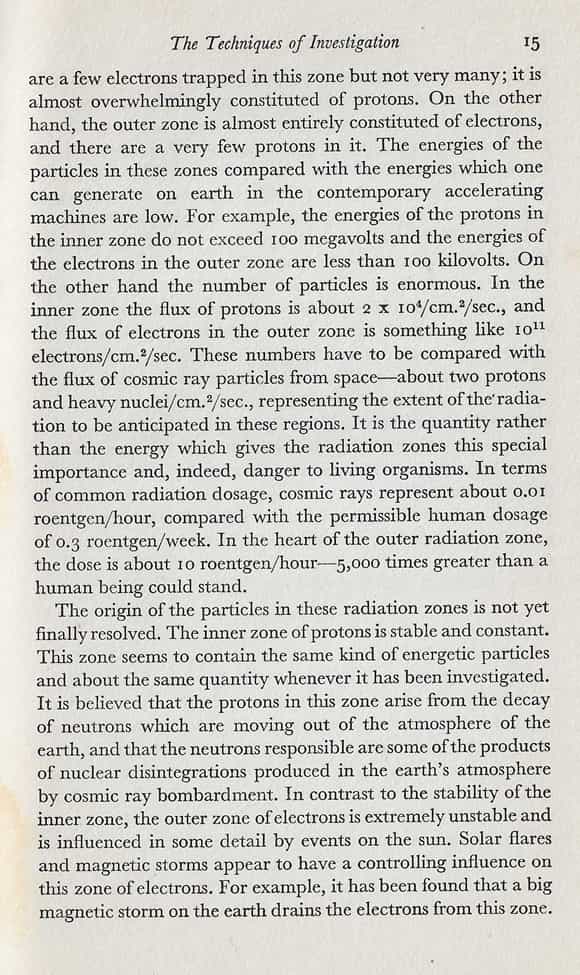
Page 15: The Exploration of outer space - (published by Oxford University Press)
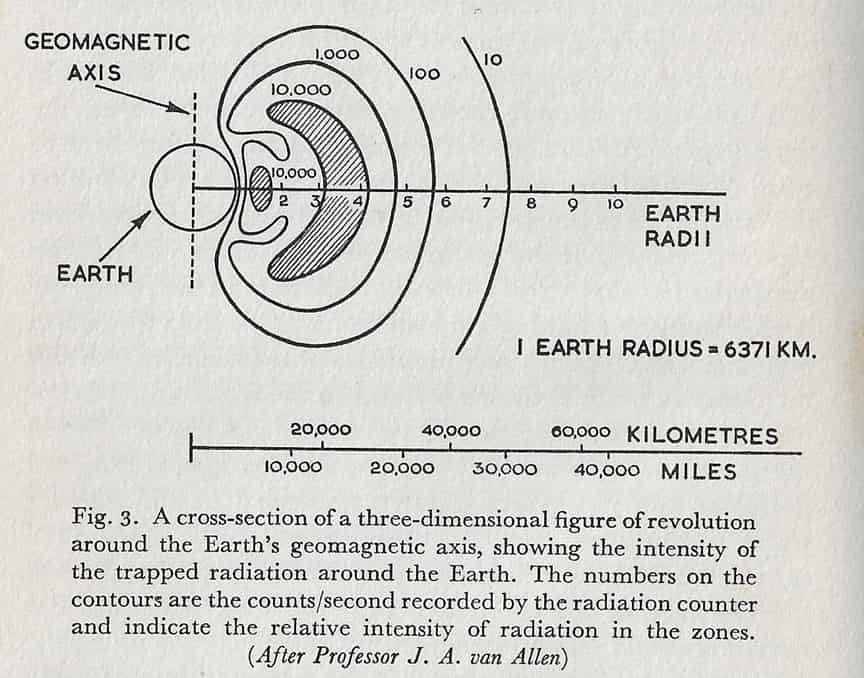
The energies of the protons in the inner zone do not exceed 100 megavolts and the energies of the electrons in the outer zone are less than 100 kilovolts. On the other hand the number of particles is enormous. In the inner zone the flux of protons is about 2 x 10 to the 4/cm squared/second and the flux of the electrons in the outer zone is something like 10 to the 11 electrons/cm squared/second. These numbers have to be compared with the flux of cosmic ray particles from space - about two protons and heavy nuclei/cm squared/second, representing the extent of the radiation to be anticipated in these regions. It is the quantity rather than the energy which gives the radiation zones this special importance and, indeed, danger to living organisms. In terms of common radiation dosage, cosmic rays represent about 0.01 roentgen/hour, compared with the permissible human dosage of 0.3 roentgen/week. In the heart of the outer radiation zone, the dose is about 10 roentgen/hour - 5000 times greater than a human being could stand. The origin of the particles in these radiation zones is not yet finally resolved. The inner zone of protons is stable and constant. This zone seems to contain the same kind of energetic particles and about the same quantity whenever it has been investigated. In contrast with the stability of the inner zone, the outer zone of electrons is extremely unstable and is influenced in some detail by events on the sun. Solar flares and magnetic storms appear to have a controlling influence on this zone of electrons.
Van Allen Belts Accrding NASA Today
NASA asserts that the van Allen radiation belts pose minimal danger if traversed swiftly. Current statements from NASA regarding the van Allen Belts indicate that there remain "challenges" to ensure safe human passage through these hazardous radiation zones, as highlighted in a 2014 video(*1) about the Orion spacecraft. In this video, NASA engineer Kelly Smith discusses the new Orion spacecraft and its upcoming test flights that will navigate through the van Allen belts. He states about the Van Allen Radiation Belts: (*1)
We must solve these challenges before we send people through this region of space.
This perspective aligns with observations made by Sir Bernard Lovell in 1962, suggesting that over the span of 52 years, little advancement has been achieved, leaving humanity still unable to effectively navigate the van Allen radiation belts.
(*1) Source Video youtube | (*2) page 15, 31 Juli 1968