
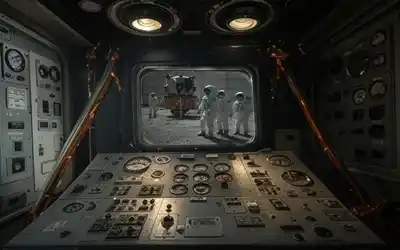
Apollo 11: Landing Point Designator
Apollo 11 LPD
In 2012 AwE130 reported a discovery that was described as amazing
In 2012 I examined some footage from Apollo 11 and observed details that were absent in the Hasselblad still images. The 16mm film shows the Landing Point Designator (LPD), a set of scribe marks on the inside and outside windows of the Lunar Module. The Commander looks through the LPD and the angle tells him where to look along the vertical  scale to find the place where the computer thinks they are going to land. This raises the question of why the LPD markings are visible in the 16mm footage but not in the Hasselblad still photographs. The initial response I received from the Apollo Historical Archive on the NASA website indicated that the Hasselblad camera was oriented in such a way that the LPD would not appear in the frame. I found this explanation unconvincing and subsequently uncovered evidence suggesting that the LPD should have been visible in the Hasselblad photograph. The accompanying image on the left illustrates the comparison between the 16mm film footage (with LPD) and the Hasselblad still image AS11-39-5843 (Without LPD), revealing that both cameras were nearly at the same position. However we aquired definitive evidence with the discovery of a small reflection in Apollo 11 image AS11-39-5843, which had remained unnoticed by NASA for over four decades.
The Reflections

Analyzing the Apollo 11 photograph AS11-39-5843 NASA reveals a small reflection on the thruster. When this reflection is magnified a portion of the LPD lines can be discerned, suggesting that the LPD was within the camera's field of view; otherwise, the reflection would not exist. Move your cursor over the image below to locate the LPD's reflection. I shared this discovery with a contact at the Apollo Historical Archive on the NASA website and received a response via email within a few hours.
"Hi Adrian,
Amazingly, you noticed something in photo AS11-39-5843 which I had not noticed before. Specifically, the cross hair reflections of some of the LPD markings which are overlaid on top of extremely bright yet out of focus sunlight reflections emanating from the ridges of one of the RCS thrusters and from the foil covering the fairing of the front port RCS assembly. Of note is that the cross hair reflections are overlaid on top of the five (5) out-of-focus aperture blades, and that the positions of the LPD crosses on top of the 5 out-of-focus aperture blades are readily discerned. This is a significant find on your behalf regaring photo AS11-39-5843, and I must explain why:
1. This proves that the actual LPD markings were within the field of view of the Hasselblad camera even though these markings are so extremely out of focus that one does not see them on the right half of the photograph.
2. An optical engineer, if provided with the optical specifications for the 80mm lens, said specifications to also include the exact position of the aperture diaphragm, and if provided with a 3D model of the LM window which includes the placement of the LPD markings, can perform ray tracing in order to precisely determine the exact location of the camera and lens when this photograph was taken. Modern ray tracing programs are readily capable of showing everything which the image plane (the film plane) should see, based on the lens parameters and due to any and all internal reflections within the optical system of the lens.
3. Multiple intense reflections of the aperture and overlaid LPD markings are visible along the left side of the forward port vertical RCS thruster. These reflections can serve to further constrain and refine the exact position of the camera lens. In a nutshell, your discovery can be used by experts in optical raytracing to precisely determine the position of the Hasselblad camera and its 80mm lens when photograph AS11-39-5843 was taken.
Best regards,XXXXXXXXXX (Name Redacted)
AS1137-5548
I have also reported reflections of the LPD seen in other Apollo 11 photographs, with AS11-37-5548 being particularly notable. Hovering over the image below reveals the number 2 displayed upside down alongside the LPD's lines. This finding prompts several questions, such as the reason for the upside-down number, the clarity of the reflection in the RCS Thruster and the positioning of the Hasselblad camera. Our contact suggests that it should be possible to determine the camera's position. If this assertion is true then this information has been withheld from me and the rest of the world since 2012, when I first informed them. It begs the question of whether calculations have been made that indicate the Hasselblad camera was situated in an implausible location, implying that the footage may have been produced in a controlled studio setting.

The Apollo 11 Landing Point Designator (LPD) And The Impossible Camera Shots!
I will now explain my reasons for believing that this footage was filmed in a studio rather than on the moon. A significant element to consider is the glare shield, which is clearly visible in Apollo 11 mission photo AS11-37-5529. This glare shield was installed between the front windows and the control and flight display panels to prevent sun light from interfering with the control and flight display panels lightings. Also see the images of the Lunar Model simulator. It is evident that the glare shield remains in a fixed position and was not detached during the Apollo 11 mission.
Maybe there was a very good reason for the Apollo Historical Archive to first suggest that the Hasselblad camera was oriented in such a way that the LPD was not in the line of sight. They understood that capturing the photographs with the LPD in the line of sight would be impossible without first removing the glare shield. We raised this concern with both NASA and the Apollo Historical Archive, but I have not yet received any response from either entity. Twelve years have passed, and the silence remains palpable.
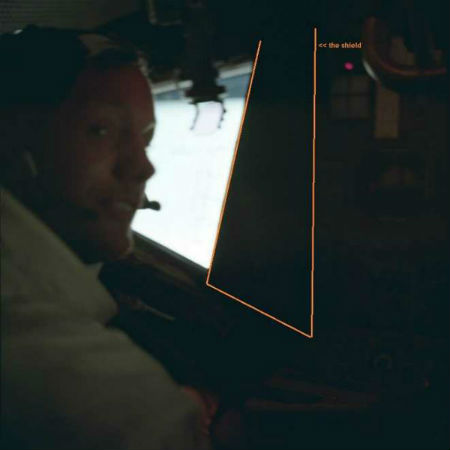


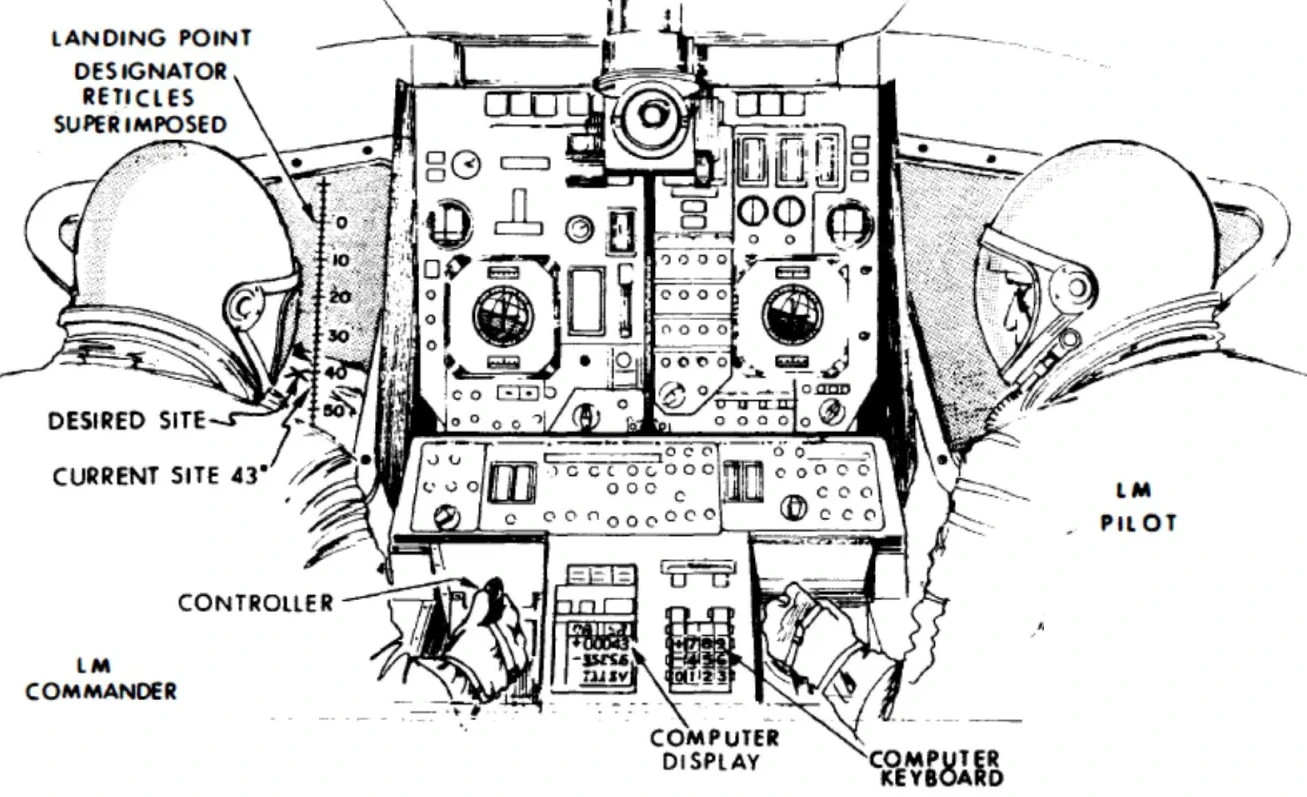

Below you can see the 16mm film footage that shows the LPD. The Lunar Module front window was made of two transparent plates approximately 1 inch apart. The LPD is marked on both the inside and the outside window. When you look at the LPD you notice the spread between the two LPD marks which would only be seen if it was filmed under an extreme angle and away from the window. There are many more problems with the LPD photographs and film material which I will address in future articles.
Credit to NASA for the photo and film material I used in this article.