
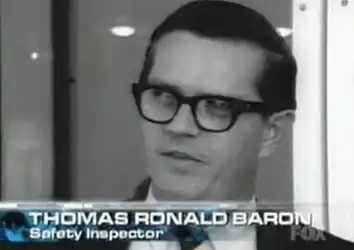
Thomas Baron and the 1967 Baron Report on Apollo Safety Infractions
Official Archive of the Thomas Baron Report
The Original 1967 Testimony of Thomas Baron (An Apollo Report)
Preface
It has often been said that "People must do what they think is right". In many cases this has been a costly quotation to follow, but it is probably one of the very few ways we have of advancing ourselves as a nation. There are too many opportunities for organisations to live off of the taxpayer. It always seems that the more tax monies that can be had, the more this money that is wasted. There is no question in my mind that there is gross mismanagement in relation to manhours and proper control of materials, and to the treatment of people. In my opinion, North American Aviation has had the funds to correctly administer a Space Program without comprimising the safety of its employees, the astronauts, or the objectives of the Project itself.
North American Aviation, has not, in many ways, met their contractual obligations to the United States Government or the taxpayer. I do not have all the information I need to prove all that is in this report. I just hope some one with the proper authority will use this information as a basis to conduct a proper investigation. Someone had to make known to the public and the government what infractions are taking place. I am attempting to do that, someone else will have to try to correct the infractions.
Thomas R. Baron
There are many reasons why this report is being written. I have been with NAA for the past sixteen months. During that time I took the time to make notes on daily happenings. There were difficulties with people, parts, equipment, and procedures. Not to mention, poor safety practices and the accidents they caused. These notes, which were sometimes in the form of letters, as far as I sent up to channels, starting with the leadman. In most cases, as I can remember, were not acted upon or never got further than the leadman.
When I was hired by NAA, I was assigned to the Quality Control Department. I was told of the of the vast importance of my task, and of the great responsibility associated with it. I was told how the slightest infraction could be detrimental to the objectives of the program. I, along with others, was told how important our job was when it came to manned launches. We were told to report every infraction, no matter how minor we felt it was. Unfortunately, this is not practiced by the Company.
The Apollo program is only the beginning, but this is not to be used as an excuse for poor operations. I was just recently told by management that we were still in research and developement even if we are going manned. I go along with this for the most part, but we should not comprimise the safety of the astronauts just for the benefit of a schedule.
Trying to keep this Project on schedule has caused a great many problems in itself. It can also be said, that because of this objective in mind, it has actually cost us much time, thereby, putting us behind schedule. Trying to keep this schedule has cost the taxpayer a great deal of money. Money wasted due to the tremendous waste of manhours, materials, parts, and equipment. The proof of the waste is not to difficult to verify. It would take an investigation of procedures and interviewing several conscientious people. I am not talking about interviewing full supervisors or managers. I’m saying, interview the technicians, the mechanics, the QC man in the area of work. These are the people who know what is really going on as far as wasted manhours and materials, is concerned.
GENERAL NOTES
The incidents that are described in this report can be put into several catagories. I have listed these catagories for the benefit and clarification of the reader.
It must be noted that all of those problems were given to my superiors at the time they took place or shortly thereafter. Many of the problems could and should have been eliminated or prevented if NAA took the proper steps to do so. Almost every case of trouble gave a clear warning as to what was going to happen. This is why I say, that if the leadman, or assistant supervisor took the proper action the problem for the most part, could have been avoided.
- Lack of coordination between people in responsible positions.
- Lack of communication between almost everyone.
- The fact that people in responsible positions did not take many of the problems seriously.
- Engineers operating equipment instead of technical people.
- Many technicians do not know their job.
- This is partly due to the fact that they are constantly shifted from one job to another.
- People are lax when it comes to safety.
- People are lax when it comes to maintaining cleanliness levels.
- We do not make a large enough effort to enforce the PQCP.
- People do not get an official tie-in time period.
- We do not maintain proper work and systems records.
- NAA does not give the working force a feeling of accomplishment.
- There is not one procedure that I can remember that was completed without a deviation, either written or oral.
- Allowing ill practices to continue when the Company is aware of them.
- The constant transfer of QC and technical types of people to different types of tasks.
- Many of the techs will tell the QC man that they have never done that type of job before, or used that type of equipment before. This is one of the most prevalant problems NAA has.
The following is a list of policies that NAA should follow to make themselves the "professional" people they should be in the first place. I am afraid the public had the wrong image in their minds when they think of project Apollo. They probably believe that everyone knows exactly what they are doing at all times. They probably also believe that the work out here at the launch complexes is done on a routine manner. They are wrong. I have been told by two managers that we are still in research and developement stages even if we are going to send up a manned spacecraft. This, I firmly believe is the wrong approach to the project. Does NASA know or realize that every spec that we have is inadequate for the task being done? Do they really know that they are changed constantly to comply with the output of quality of the part or system being tested? Are they fully aware of the comprising position that NAA has put the program in? Do they know that of the great number of people we have working on the hardware are not satisfied with their own work and the work of others? NASA is not even aware of the vast snags that go on in receiving inspection. Do they really know where all the parts and materials come from? I believe that all these questions can be answered, with the word "No".
- If an OCP has been written for a specific system, it should not be changed.
- Process specifications should not be changed to conform to the results of a test on a component.
- Men should be assigned to a specific task or area and stay there. In this way his chances of promotion increase. Too many people get "transferred just before they get used to a system or work area. If they stayed where they were we would really be building a "professional" group of engineers, technicians and mechanics. As it stands now, we have very few.
- Our supervisors or anyone else that writes Internal Letters should coordinate with the people that will be affected by the letter. In most cases this does not appear to be done."
- We should completly eliminate all verbal orders.
- All launch people, troubleshooting people, systems engineers should work much more closely with NASA. I believe if we had more NASA people to see if the contractor is meeting their contractual obligations many problems could be eliminated. I would think that a project of this magnitude, would warrant this surveillance.
- A safety group that would take care of safety infractions immediately.
- Schedule shifts so they give a man a firm tie-in time that they get paid for.
- Immediately investigate improper practices and don't sluff them off.
- Solve their vast problem of communications between all the people.
Many of the problems that are written about, have to do with the morale of the working people. There has been, at different times, a great deal of apathy on the part of these people. Much of this is caused by poor working conditions for that are prevalant in some areas. At pad 34 the bath room facilities are extremly poor. There doesn't seem to be enough trailers available for the working personnel. The technicians at one time had all their tool boxes, extra clothing, etc. in a small semi-truck trailer. The technicians also stayed in this trailer. They had no other place to go. Many times we had to be exposed to the elements for extended periods of time, there were no people to relieve us or no one scheduled a relief. People have missed lunches due to this problem. The laxiety of the Company to protect the men by enforcing the safety policies, was another worry of the men. I remember a man that refused to go into a scape operation, because he did not feel save. He had to report to the assistant QC manager.
The constant transfers of men from one task to another, even if they are in the middle of a test, is distracting to the technician. He never really knows if the test was completed properly or if some problem arose that he could have helped with because he was familiar with the original set-up. He is left without any feeling of accomplishment for the task he started. NAA does not realize that this feeling is important to a good technician or mechanic.
JOB CLASSIFICATIONS
It has always been my understanding that if you want a Company to function properly, you must have a set of rules that you must adhere to.
In the case of a small firm, working on a government contract, rules are made up and for the most part are designed to fit the company and the needs of the contract. Such is not the case at NAA. Regardless of what a man’s 63-P Form says (Employee Requistion and Change Notice) he may have to do work he is not qualified to do. My own personal 63-P states that I am an "Inspector, Missile Preflight-Electronics" I have attempted to find out several times just what this includes, I have never been able to find out. I have worked in the following areas. I may or may not be qualified to work in them but I, along with others are forced to do so. The areas include working on any piece of ground support equipment, electrical or mechanical, the spacecraft battery lab, the SITE lab, receiving inspection, life support building, quality records section, shipping, the service module, the command module, the Lem adapter, and anywhere else NAA saw fit. It is impossible for any one person to know what they should know when they have to work in these different classifications. You can add to the above list Blockhouse operations conducting component and systems test. Myself, as a LG-12 has to work directly with engineering in the blockhouse. It is the duty of the blockhouse QC to see that the test is being run properly. He has to make sure that the engineer is not "snowing" his way through a problem in order to get a test run and completed. This is not an uncommon situation. The QC man in the blockhouse must have a good familiarity of the system in test. He must have a good knowledge of safety practices and use good judgement on behalf of the engineer and the objectives of the test. When I worked in the blockhouse I was a LG-12 and not even at the top scale. The man in this position should be at the least a top LG-17. Lower grade people do not get paid enough to have this kind of responsibility.
I have given an account on my own particular case, but, technicians, mechanics, other QC people and even engineers are also changed around constantly. This is not a real problem in engineering, I believe any change made there was strictly for one shift due to absence or illness of the regular system engineer. In other words, it was definitely a temporary change.
NAA should make a new job classification for all their technicians, mechanics, and QC people. It should be clearer defined as to what their precise responsibilities would be. A man could advance himself better, he would eventually learn "his" system to a "professional" degree, and I believe that this is what we should be trying to accomplish. I can see how many problems could be solved by this method. If we are in the process of building towards a "Moonport" this is the kind of beginning we need.
TERMINATION
I had an official "OK" to return to work from the Company doctor on the 5th of January.
When I returned to work on the 5th of January, the following events took place.
I walked into my supervisors' office at 1445 hours. Mr. Buffington seemed happy to see me. He immediately took the Doctors' Report from me as I handed it to him, and he said "Lets go upstairs to Johns' office". (John Hansel, QC Manager) When we arrived upstairs, I was told to wait in Johns' office for him. Mr. Buffington had gone down the hall. In about twenty minutes John and Don came into the office. I was ushered into the office and I sat down at the long table in the office. As soon as I had sat down John said "You've got your car here, drive down to the CAC and I'll meet you there, something about a problem that Labor Relations wants to see you about"
When I arrived at CAC, I went into the Labor Relations office, and said "hello" to Don Ulsh. Another man was there, but I don't recall his name. He was also Labor Relations. Shortly thereafter, John Hansel came into the office and as he did, he closed the door behind him. Don Ulsh spoke first. "I'm sorry, Tom, but I have an unfortunate task to perform." I knew at that time I was going to be terminated. I immediately told Don, "Don't feel bad, Don, I was expecting this and added, "It is no surprize to me." I then asked John what some of the reasons were, and he told me the following;
- That I was not taking care of my personal financial problems
- That my ex-wife had contacted him on several occasions.
- That I had been served papers at work.
- That for the past twelve months, due to my illness, I have only been on the job eight or nine months.
- That he did not like the way I had handled this report in reference to newspaper people. He did not think I should have given them the information I had collected.
- He felt that I was channeling my efforts in the wrong direction.
- I asked him if my work had anything to do with my termination. He stated, that as far as my work went, he couldn't ask for a better job.
- I was terminated at four o'clock that evening. It was a very sorrowful event for me. There is nothing more that I wanted, than to associated with the space program.
NASA PARTICIPATION IN APOLLO
We definitely need more NASA coverage in all aspects of the program. There are too many times that the authority of a NASA counterpart could have helped the situation.
In receiving inspection there is no NASA. This is to say there is no NASA there to survey the work. I sincerely feel, that if NASA were in the area, many problems could be prevented and others kept from getting larger. We don't have a NASA man in this area to verify any shipment made on second and third shift. This coverage was eliminated by a letter.
If more NASA people were on hand in the areas there would be a lessor tendency of NAA techs, engineers, and some QC people to try and "snow" their way through a task.
I have also seen where NASA did not take too much interest in a job. I had occasion just recently in the SITE lab where a NASA man was more interested in his "skin" book than in the test in progress. Then again, I have worked with some that I was proud to be associated with. Men that didn't bend to the point where they were comprimising the safety of the astronauts or the objective of the Project.
POOR WORKMANSHIP
- Mechanics manufactured a "new" one-quarter inch line. It was being sent through receiving inspection enroute to the Bendix labs for cleaning. The "new" line had a new part number etched on it, but it was of extremly poor quality. It was hardly legible. Unfortunately, this same line also had another part number on it. This part number was hidden with a piece of masking tape. It was neatly wrapped around the area where the number was.
- When inspection had asked service engineers to make sure they had the type of system (fuel, oxidizer, oxy,) on the Vendors' Instruction Sheet, they would not, for the most part, comply. In one case, when I had asked an engineer about it, he said he was going to mark all the lines and fittings "For GN2 Systems", This is one system that doesn't require any special cleaning treatment (In the critical systems, the use of lubricants and the type of system determine what cleaning measures are required.)
- A clamp that held an ECS valve in place in the command module was damaged. The engineer straightened out this clamp by hand and wrote "OK AS IS" on the DR. This clamp was a replacement for another clamp that was damaged during packaging or shipment.
- People sleeping on the job when they should be watching consoles. This was a constant problem during water glycol testing.
- People read magazines, newspapers etc, when they should be monitoring panels on consoles.
- Men coming to work on the pad with alcohol in their system in excessive amounts.
SPACECRAFT 012 CONTAMINATION
One day when I got to my work station, which was the 28 foot level at the MSOB, I noticed a contractor workman cutting a hole through the steel flooring. He was using a sabre type saw. It immediately crossed my mind that the command module was below us and to the left. I asked the workman to stop what he was doing, which he did. I then notified NASA QC. Immediately the NASA QC man went down to the command module and examined it for possibility of contamination. We were a little too late. The module had a good coating of metal dust and filings on it. The NASA QC inspector wrote a DR against the module because of the contamination.
Previous to this problem, I had asked engineering and my leadman to install some type of cover arrangement over the command module to protect it. There was always a chance of dropping hardware or tools on the command module. This was never done.
It would also have been advisable for the workman to coordinate with the proper people to see if he could do his job at this time. It was not entirely his fault. There were technicians, mechanics, QC, and engineering on the level when this man started cutting this hole. Why they did not foresee the problem, I do not know.
INSTALLATION OF HEAT SHIELD ON SPACECRAFT 012
Due to an inadequate supply of the proper tools it was extremely difficult to install the ablative plugs in the heatshield. I believe that the actual work started on the third shift of the previous night. It passed through the first shift with no work accomplished, and now it was on the second work docket. For the next eight hours there was little gained in the work. Due to the lack of proper informed people, no one realized the plugs were not all the same size. I for one did not know it, the techs did not know it, and the leadman did not know it. It was a problem of using the wrong people for the wrong job. When we finally got straightened out on the plugs, we ran into another problem that no one was aware of. The command module was attached to its stand in the MSOB. The ablative plug holes were inaccessible because of the stand. Apparantly, the GSE designers were not aware of the fact that the plug holes had the same perifery as the framework of their stand. I left that night and only one plug was installed, a very short one. How the other plugs got installed, I do not know, the next day I was on another assignment.
RENDEZVOUS WINDOW INSTALLATION SPACECRAFT 009
The following is a very typical operation as to a specific task. This work involved the installation of instrumentation on the window panel. The task was on the incentive loss list. It was another case of a rush, rush deal to meet a schedule. Because of this and other problems encountered, the task took longer than it should have to be completed.
- There was no leadman working with the technicians on this shift. The techs had to work directly with service engineers to acquire parts needed. This is common practice on this shift (2nd).
- There was not a Bond room attendant on duty when we required parts. Much time was lost waiting for parts and tools needed.
- NASA did not fully cover this important task. They did not witness much of the work. When a portion of the task was done, they were called and the work that was just done had to be gone over again verbally for the sake of NASA. This slowed down the completion of the TPS.
- It was difficult to really verify if we used the proper parts because some of the parts were not identified except for a parts tag.
- We had a tremendous pile of specifications to read and comply with before we could complete the installation. In some cases, one specification will list as many as ten other specs that it is involved with. You can imagine what it could lead to.
- Instead of the three or four days it took to get this job done, it should have only taken two.
LIFE SUPPORT OPERATIONS
The following is what I feel is standard operating procedure in the life support area. I base this on the fact that I have witnessed some of the worst performance of technicians and engineers since I have been on this contract.
We were in the process of preparing to check out a ECS pressure relief valve for spacecraft 012. We were supposed to use the leak detector in the C14-415. But unfortunately it was not in working order. It seems it hadn't been serviced for some time. There was water in the system, but it was not usable due to the amount of air in the system also. As usual, the second shift engineer picked up the telephone and called his first counterpart, this seemed to be normal procedure for him. The first shift engineer told him to use another gage on the panel. The gage he told him to use was a "0 to 1oo" pound gage within accuracy of two percent at full scale. The tolerance of the pressure relief valve leak test was supposed to be a decay rate of no more than two tenths of one pound in fifteen minutes. This leak rate was not possible to see using this gage.
This same valve was supposed to maintained to a level three as far as cleaning was concerened. The interior of the valve had a large amount a black substance in it. This was later found out to be a thread lubricant. The valve was cannibilized from spacecraft 020.
When I suggested another gage be used, a call was made and soon another gage arrived. It was a large Heise gage with a range of zero to one thousand pounds. It was also marked with a red lable that said "RCS SYSTEM ONLY". It was the technicians suggestion to remove the tag, use the gage, and put the tag back on. These kind of people make me sick. We have these kind of people on this program and we don't seem to be able to do much about it.
TIME-1966
General Problems
- Engineers' operate check-out consoles during testing.
- Technicians are not familiar with the equipment they operate.
- Technicians constantly operated consoles without proper authorization. When a gage did not respond when the procedure was followed, the technicians opened and closed valves experimentally to see if they could get a response. Engineering also is guilty of this.
- Interchanging of plugs, caps, small hardlines and valves, and other fittings between work areas. A unit used in a water glycol test could be used in a pure water or liquid nitrogen test set-up. It is basically a part contamination problem.
- Rusty water was found in the C-14-415 or the C-14-416, I don't recall which, but the unit was used in the testing of the Potable Water Reservoir. It was said by dayshift people that this water was pumped through the unit.
- The consoles in this building are not checked out before they are used for a test. This is supposed to be accomplished per the procedure of the unit in test.
- Paperwork (TAIR BOOKS) of the consoles were found in some cases three months behind in their completion. This leaves the configuation of the unit unknown.
- The process spec of the component in test is ALWAYS deviated from with the use of a TPS. This eliminates portions of the process specification and often changes the tolerances of the component being tested, usually because the component did not meet the actual specs or it was "borderline".
- Lack of proper handling of parts.
- Use of filters in the consoles that do not have the proper micron rating.
- The exterior doors to the various clean rooms where testing is done, are constantly opened by technicians. This allows dirt, insects, and other contaminants into the room. It is impossibe to keep a clean level of an important spacecraft part maintained.
- Technicians do not use face shields, tie-down chains, or any other safety device in high pressure testing.
- Many items do not get proper cleaning, but somehow inspection stamps them off.
LIFE SUPPORT NOV-66
During the cleaning and assembly of the tank door and the standpipe, several operations were noted that jeprodize the integrety of the unit. No steps in the TPS to tell the technicians how the tank door was to be assembled. This portion of the TPS was supposedly in work at 1500hr that day. As of 1900 hrs that same night, there was no Mos sheet made up.
The stand pipe was assembled with out any torque value. The area did not have the proper tools to do the job. (a crow's foot of the proper size was not available, instead they installed it with a large cresant wrench) The unit was supposedly cleaned to Level two. This is not possible in a system that has teflon tape in the unit.
Inadequate people to verify the specific clean level. The unit was improperly packaged. It had an inner sealed bag. The outer bagged was intact until a technician stampled the parts tag and clean level tag to it. This is not allowed on this second bag. The tank door and pipe assembly was not packaged properly for delivery to the s/c. It had no other covering aside from the aforementioned bags. It was then carried into a carryall by two men. It naturally did not fit into the carryall completely. The pipe assemble was fourteen feet long so I would say that at least five feet of it was hanging outside the rear of the carryall. At this time it was still being held by the two technicians. This complete procedure is against transporting and cleaning specs. If I would have made any attempt to stop the people and hold up the test I would have had the night supervisor on my neck again. Why all this goes on, and why the people higher up don't realize the risk involved in some of this ill practices, I'll never know.
TIME- November 1966
Record keeping in this area is very poor. There is one desk in the area that is used as a "filing cabinet" for many different records. Some of the records are just laying around in the different drawers at random. Some of these records include the following:
- Cleanliness records of all the different facility gases used.
- Cleanliness records of all the different facility liquids used.
- Cleanliness records of the different rooms in the building.
- Cleanliness records of the different gases in the check-out units.
- Cleanliness records of the different liquids in the check-out units.
- Records of the different units that have had a preinstallation test.
- Many TAIR books that are of the soft cover type.
There is also a duplication of "official" records being kept in this area. Much confusion can result from this if it is not taken care of now.
Normally, when a component must be tested, an engineer will write a TPS. He then should notify the area inspector that a TPS has been written. The inspector, in turn, logs this TPS in the Space Craft Spares TAIR Book. Unfortunately, this book is about a mile down the road. It is kept in receiving inspection area at the warehouse. The inspector seldom calls anyone at receiving inspection to log the TPS into the book. It is usually done after the TPS is complete. This is a complete reversal of normal procedure. A TAIR book is also kept in the life support area but it is not an "official" book. The book in the life support area gets all the required stamps and the book that should have them is in receiving. If this sounds confusing to read. imagine how difficult it is to work with.
I was told when I went to work in this building that I was not to create "waves" and above all, don't stop any tests, no matter what. This was said to me by my assistant supervisor, Dick Shrieves.
TIME- November 1966
Spacecraft 012 fuel tank worked on without any paperwork. Standpipe was installed on tank door assembly without any specified torque value.
The actual clean room in the building is not properly maintained as a clean room. Papers, pencils, forms, staples, and many other unauthorized items are used in the room constantly.
- The repairing of steel flex lines with common pliers.
- Very few hoses in the entire building that have a proper hydrostat date.
- I was asked by clean room technicians to stamp off cleaning of items I did not witness. Apparantly, previous inspectors did stamp of work they did not see accomplished. Technicians seemed perturbed because I refused to stamp these items.
- Quality Control inspectors use the same time charge for running tests on parts going directly into the spacecraft as they do for receiving inspection in the warehouse.
- The use of meters or gages that do not have the required accuracy for the test in progress.
- There is no Official tie in time.
- Fuel tank line (bypass) for spacecraft 012 manufactured without any paperwork. This same line was allegedly deburred with a pocket knife.
- Improper appropiation of parts needed for work in this area.
- Some testing processes used on spacecraft parts are not documented. Reference to the drying and vacuum method of these parts.
- Constant loss of paperwork in this area.
- The following are some specs and letters that are not fully complied with.
MAO616-035 Clean Packaging Spec.
FG-962-T Inspection and test record form
FF-RAE-66-004 Clean Room Activation
APOP 0-209 Pre-Installation Testing of Spare Parts.
QUADS
PROBLEM REPORT
DATE April 18,1966 second shift.
LOCATION MSOB Quad Test Area
SUBJECT NASA participation in test
TO: R. Rongstad, Supervisor
- NAA engineering worked directly with the NASA QC in advance of NAA inspection. NAA Engineering operated valves, switches per the OCP. Realizing the importance of maintaining a proper cleaning level. NAA QC attemped to observe as much as was possible of the connection of QD's and test point lines and still keep up with the OCP's operation. I had to retrace steps often to assure myself that the proper valves had been operated etc. Had the Engineer not been in such an Accelerated rush, the test would have gotten the total complete coverage it required.
- At times portions of the test were run by NASA QC. He personally directed technicians to correct/disconect lines operate valves etc. NAA Engineering and NASA Engineering were in the area at most times.
- NASA QC physically connected/disconnected or assisted in removing lines/fittings, etc. from the Quad in test, NAA QC. realizes that NASA QC was helping, but he has no real business doing so. The mechanics are expressly trained for their work and they have the desired experience. The quick disconects are difficult to connect, and they are expensive, they are also easy to twist and deform. Experience mechanics are the best qualified to make such connections or disconnections,
- I have been approached by other NAA QC on the above subject, they have also encountered similar problems on the command module.
QUADS
SPACECRAFT 011
- Engineer John Tribe operated almost all of the test equipment by himself.
- Engineering did not wait for QC inspector to verify many steps.
- Tolerances were deviated from constantly.
- Almost a total lack of safety procedures during testing.
- Technicians, who were very capable, could not operate the equipment. They had to stand around in the area.
- One copy of the test procedure was used for four seperate Quads. This made it very difficult to follow the test proceedings.
- Very poor workmanship on splicing of instrumentation on the Quads,
- Quads transferred to different areas without proper paperwork.
- Flagrant violations of cleanliness of the Quads.
- Splices were not the proper size. (instrumentation)
One Quad was left in the middle of the MSOB floor. There was work done on the day-shift which resulted in metal shavings, filings, etc. by another contractor. The work was done approximately fifteen feet away from the Quad. The only part of the quad that was covered were the engine nozzles.
Another quad was found in a room in the MSOB, next to a work bench that also had metal work done on it. This bench was four to five feet away from the quad. Metal shavings and dust from a drill press was on the work bench. (3.5.66)
Still another quad was found in the MSOB hi-bay area totally uncovered. Length of time it was uncovered was not determined, (4-28-66)
Some quads were received in such a poor condition, they had to be sent immediately back to Downey, California.
Possible Quad Contamination
Time- %-5-66
Quad "D" was transported from the twenty-eight foot level of the hi-bay area of the MSOB to room 1400 of the MSOB. I noticed that the unit was not protected from contamination. The only thing on the unit that was covered were the engine nozzles. I notified the proper people so I could gain access to the room. Then I notified the NAA leadman. Together, we went in and examined the quad. We found a work bench in the area very near to the unit. It was covered with metal shavings and filings. (the workbench) I asked the leadman if we could get the unit covered and the room cleaned up. He realized the importance of the problem and asked a technician to cover the unit and another one to clean up the area. I assisted in covering the unit, the technician that was asked to clean up the area seemed extremely reluctant to do so. This occurred on a week end and the normal clean-up crew was not on duty.
- The use of any tape on the PUGS covers was detrimental to the unit.
- Burrettes used in testing were rusty, corroded, and not identfied. 4-25-66
- Invernol found in technicians tool bag. Out of date and not to be used.
- Oxidizer blanket cover latches had the safety wires cut from them and in process to be removed and there was no authorization to do so.
- The oxidizer sensor wires were also removed from terminal board number four without any authorization.
4-11-66 QA. MSOB. Hi-Bay
Typical Day of Quad Work
Subject Quads
As usual the confusion here is no less, than anywhere else. The situation looks almost hopeless. Parts are not here, work being accomplished wrong has been redone. Cleanliness specs. are not being abided by. We will end up in deep trouble.
Why can't we have organization and the type of supervision we need, the lack of even the most inexpensive tool is one major problem and it is rediculous. Crimping extraction tools and the similar types of tools, the lack of coordination.
QA.4-14-66 MSOB "B"OCP K4072
- Put shortage sheets in QD-A Book
- Pick up dates on stamp.
- Calibrate equipment up to date.
- Check B/O Box, for propriety.
- Pick up on page #60 of K4072.
- Extreme noise in area, jack hammer being used approx, 150 ft away and below this 28' level.
- Bought off TPS,003 and MOD #1 on Quad C.
- Oxidizer blanket sensor wires removed from TB4 without auth.
- 15 of the blanket latches have the safety wires removed.
PROBLEM REPORT
Date April 18,1966 Second Shift
Location, MSOB, Quad Test Level
Problem Subject, TPS, writing and initiation
Originator, Thomas. R. Baron
Supervisor, R. Rongstad
- The problem arose when NAA, QC. was on the 28 ft. level in the Quad area, above the command module. A sling Assembly with the H-14-143, serial no.3 was attached at about the same time, a NAA Technician handed NAA QC a type B-TPS including the engineering copy.
- It was a TPS written to transfer two seperate H14-143s to this level. Both units were on a TPS that was written for serial no.1. The TPS was not logged, or not even seen by inspection, and a associate contractor had our equipment and the wrong one.
- Work stoppage, because of lack of people. Could not transfer the Quads.
QUADS
During the quad checkout a valve was removed from the C-14-075 unit. There was no paperwork to do the work. QC was never notified of the work to be done. The tecnicians removed a valve, supposedly repaired a leak in the valve, and were in the process of reinstalling it in the console. It was at this time that I noticed what they were doing NAA was aware of the work and in fact aasiated in it.
The quads were usually received from Downey in less than desired condition. Sloppy workmanship was the usual squak, several times loose washers, nuts, etc, were found. In some cases metal filings were found inside the packing crates and on the quads.
No splices available for size 32 gauge wire. This wire is used extensively in instrumentation installations. Larger splices with a fill in wire must be used.
QUADS
I had just gotten to my work station on the 28 ft. level at MSOB hi-bay area. A test was in progress on one of the quads, another quad was nearby. I looked over the area and noticed at this time that the entire quad was totally uncovered, including the engine nozzels. I immediately asked the engineer how long it had been in that state and he said about one-half hour or so. He did not seemed concerned with any type of cleanliness problem with the unit. I immediately examined the nozzels for contamination and the only thing I could see was some dust. The nozzels were then wiped out and properly covered. S/C oil.
QUADS
TIME- 4-21-66
AREA- 28 foot level of MSOB hi-bay
SUBJECT- Accident
A leaky valve had been found behind the C14-075 console. It was a facility helium valve. The leak was said to be at the stem of the valve. This valve has a six-thousand pound input with about three thousand pound output. The valve was removed by Bendix people, I believe, and supposedly repaired. It was said that the repair consisted of tightening the locknut at the stem. The valve was returned and re-installed.
A NAA technician was instructed in the opening of the valve. He positioned himself over the valve and partially opened the valve, with no response. He then opened the valve a little more, which resulted in no flow. He was then instructed to open the valve further. There was still no flow at this time. At the next attempt to open the valve, the valve was said to have blown apart. I don't know what pressure was on the valve at the time, but it was considerable. Whether or not the man was injured, I don't know. It was rumored he lost an eardrum. This can be checked by records.
The above accident could well have been avoided. The injuries to the technician could have been minimized. I had asked the engineers working on these high pressure quad tests to please get faceshields and other protective devices for the technicians, many many, times. During the conducting of these test we used 4200 pounds of pressure on the quads. I talked to my leadman and my assistant supervisor about the use of safety equipment, but to no avail. I hoped they had talked to the engineers about it, but they too, have many areas to cover and little time. When I asked about safety gear and its use, engineering just brushed it off. It is a disgusting situation.
When the above valve was removed again to the malfunction lab, the facility line leading to it was not restrained in any manner. A tie-down chain should have been used. I had one installed when I contacted the leadman of the area.
WATER GLYCOL OPERATIONS IN GROUND SUPPORT
Most of the following problems took place on spacecraft 009 and 011. I have not been working on the launch complex for spacecraft 012, so I am unable to say whether or not these problems still exist.
List of engineers that have worked on the water glycol system:
Mol Gill - Bill De Journotte
Bill Amoroon - Sam Moody
Chuck Leavitt - Ed Wright NASA
Dennis Jolly - Jerry Dahl, Airesearch Corp.
Most of the troubles we have had with the water glycol system seem to stem from the fact that the equipment has not been properly designed, operated, or maintained. An examination of the units could prove this out. The poor workmanship on the Vendors' part could readily be seen.
In most cases, when a part failed and had to be replaced there were no drawings available. Drawings for the units are rare indeed, the factory representatives' drawings are not up to date. He told me he was using his older, outdated drawings because his newer ones had been lost. Even the older ones' were not available to us when they were needed.
Many of the engineers' did not even agree on many of the problems and results of troubleshooting. They did not agree on the operation of the units. There were discussions over the headsets as to which valve did what when it was opened or closed.
During the support of coolant to the spacecraft and even when we were just circulating in a loop configuration, safety procedures were practically forgotten, and a clean level was not properly maintained. Even the area at the base of the umbilical tower, where the units were located, was usually in a dirty condition. Cigarette butts, damaged sand bags, lunch bags, etc. were always in the area.
WATER GLYCOL SYSTEM
Many of the problems we have had on this system derived from operating the equipment in an adverse way. I have listed these below.
- Operating with "Over Temp" warning light "ON". for months.
- Operating with "Over Press" warning light "ON". for months.
- Operating with over press and temp as indicated by the panel motors.
- Many times we operated with off scale high readings for extended periods of time.
- We operated with valves so hot, you could not put your hand on them. We have operated with the water glycol pumps hot and smoking. Operating with a"low level" warning light "ON".
- Operating with valves in a midway position because no one knew what was "OPEN" or what was "CLOSED". (Ref NASA panel installed by subcontractor.)
- The technicians operate many of the valves and switches without any authorization from anyone, and nothing on paper. Many hours have been wasted attempting to locate a problem, when the only problem was, that the unit was not in an operating configuration, due to someone changing it and not telling anyone.
- Experimenting with the units without any paperwork to cover what was being done (Ref; blocking the condenser coils of the S14-019R)
WATER GLYCOL
Situation Report.
T. R. Baron QC.
Jan.22, 1966
During the support of S/C 009/ Water glycol servicing the second shift personel were informed by first shift engineer that there would be no second shift engineer immediatley available. The day shift engineer had given a technician his home phone number in case he was needed. I was supporting this effort from & trailer in the support building area. We also had a QC. man on the pad level on the S14-0538 I asked the engineer for his number also since I had a phone immediatly at hand.
At the time the day shift engineer left, the following is the configuration the water glycol system was in.
Unit #2 of the S14-053 and 514-019 were in operation, we were experiencing a fluctuating supply temp at this time. The day shift engineer told me if it persisted that I should go ahead and write it up. We were operating under an over temperature light. This condition had been written up for some time, with no action taken. I personally told the engineer this and I was told quote " I'm going to forget about it". unquote. We also had a leaking quick disconnect at the NASA interface. The condition of the line was unknown because it was leaking so bad that no one would touch it. It had a red tage attached to it. The leak varied in relation to the system configuration. At times the QD leaked at a rate of 40 drops per minute.
The back up system was not in operation at this time. In fact, the S14-019R was not even operational at this time.
In case something would have happened that shift, the technicians and myself would have had a deceision to make. It would not have been difficult for us to bring the back up system on the line but we have no authorization to do it without engineering OK. We were having and still did have extensive problems with this equipment, the engineer had no right to leave us alone with it.
WATER GLYCOL
Problems and discrepancies
Drain lines and other lines constantly plugged or capped with dirty parts.
Date 12-10-65, Today we boiled water glycol when the engineer was experimenting with the system. This occurred when different adjustments were being made on the Variac, which was on the eighth level of the gantry.
On the same date, I made a note of the terrible headset manners. This was a common problem.
Nylon or plastic plugs were constantly removed from the solenoid valves. They are removed so the valve can be operated with a common SCREWDRIVER, when they did not work electrically.
There were approximately twenty-five to thirty major discrepancies on the water glycol ground support units immediately prior to the launch of spacecraft 009.
Date-11-17-65, During a calibration of the temperature probes, which were located on the two-hundred foot level of the umbilical tower. The calibration people had taken an open container of alcohol to that level to use in the test. An attempt was made at this time to insert probes into the container. The calibration people had several test leads connected to the probes. The took no precaution against the possibility of shorting the leads. They were quite perturbed when I asked them to consider some sort of safety measures, such as insulating the leads. Only after I insisted that this be done did they comply. It was still an unsafe procedure to use because of the alcohol.
I was in the blockhouse during this operation and there was no QC man at the tower, needless to say, it is difficult to handle such problems when you are not near the work area.
WATER GLYCOL OPERATIONS
Use of "monkey putty" directly on the lines and fittings, and valves on the trim units. This caused a tremendous waste of manpower during a dismantling of the unit. It was very difficult to clean and remove from the unit.
Tried to locate a complete console one day and no one knew where it was. It was "lost" for two days. (S14-053)
It is very difficult to verify if the calibrations are up to date on the units.
Parts are removed and installed without any paperwork. (Filters, special clamps, etc.)
Due to lack of print the wrong relay was changed. (K-5) Many valves on different occasions had to reinstalled also because of this.
WATER GLYCOL
Jan 6, 1966
Condition of system at this time.
- This was the third attempt to complete this particular test.
- Number one pump was not working properly.
- Number two pump was burnt up at 1740 hr.
- Back up system was in repair.
- We still had the leaking QD on the NASA interface panel. Flowmeter did not have a completed calibration.
- No QC coverage in some area.
It appeared today that the engineers on the system were getting apathetic about their work. They did not seem to be too alarmed or concerened over the situation. The lack of going by procedure was evident. Perhaps with all the difficulty we were having, going by any kind of a procedure was out of the question. It would have been wise at this time to shut down the entire operation and repair the entire system, and then try to run the test as it should be run.
WATER GLYCOL OPERATIONS
This incident was not unusual. It clearly shows what would happen if there were no Quality Control. If most of the engineers' had their way this would be a common format for them to use.
- A vacuum pump that is used for the pulldown test on the water glycol system had finally quit operating. It was the second one in several days. The following was done without any authorization or paperwork. Quality Control was not informed as to what was going to transpire.
- The engineer had the pump removed from the 200 foot level of the umbilical tower.
- He then had it transported to a seperate work area away from the pad. He had the complete pump assembly dismantled.
- He was attempting to install other parts from another bad pump into this pump.
- All of this was done without any paper work or under the surveilance of a QC man. Furthermore, Quality Engineering was not able to determine why the pump failed.
It is situations such as this that go on and they should be stopped. It seems to be the engineers' first desire to get his system, into operation and hang the documentation. This is very unfortunate, but it is quite common. They seem to have the wrong attitude and objectives. They are not looking to the future at all, their only concern seems to be for the present.
WATER GLYCOL SYSTEM
This situation took place on s/c 011.
An engineer was transferred to the Florida facility from the Los Angeles Division. He was sent to be the responsible engineer on the water glycol system for the second shift.
This engineer was put in a most uncomfortable position. He was not the least familiar with our procedures or paperwork. He did not even know what the specific forms were to do his job. I would like to make one thing clear, it was not this mans' fault. He was just put into this slot because they needed a man.
The mans' name was Bob Lucas. He seemed to be really in a jam. One of the most interesting aspects to this situation was the fact that he knew little or nothing about the water glycol system. We did all we could to help this engineer. In fact, I, myself wrote a TPS to service the one unit, for him. When this engineer took his place in the blockhouse one night, he did not have the capability to run a test. He could not even operate over the headset and admitted that he had a bad case of "stagefright" and turned the test over to someone else. Situations like this should never exist in a billion dollar program.
PAD 34
- Lack of mechanics to maintain cleanliness on flex lines.
- NAA has to borrow tools from other contractors to get the job done.
- Circuit breaker kept blowing on the N2o4 transfer unit. For as long as I can remember this breaker kept blowing and was just reset. I don't know if it has been repaired as of this date.
- Headsets were a tremendous problem. People was stashing them. stealing them, etc.
- Many times the QC had to give his haedset up to a tech so the tech could, do a task. This prevented the QC man to know what was going on with the test.
- One QC man had to cover as much as four or five jobs at one time.
- Lack of scape suits for all people in a test. On space craft nine, I remember when one group of people lived in their scape suits for three or four days, during this same time another group of workers played cards, slept, etc, for the same period of time. The reason was that there were no scape suits available for them to wear. We were working twelve hours on and twelve hours off. The waste of money was tremendous. Sometimes we the second shift didnot have suits until late at night, and everyone goofed off until we received them.
- Communications during scape was terrible. Many times the trailer could not be raised on the headset. This created a lack of confidence with the people in scape on the gantry. Sometimes the scape trailer did not know who was on the pad.
- The practice of straightening bent pins in various connectors became common practice.
- Work was gererally poorly coordinated at the pad. Much time was lost in waiting around for parts or equipment/
- Identification of lines is very poor. Fuel and oxidizer lines were not marked as such. It was easy to confuse the parts.
- There were times when we had so many techs around they couldn't find a place to hide.
- A PCM unit was found on the 200 foot level of the umbilical tower exposed to the elements. It had been raining. I told the proper people and also covered the item. The next day it was still there, uncovered.
- The PCM unit is a costly item.
- The common problem of seals being broken on patch panel etc. existed at this pad also.
- Hardware found laying around loose in these patch boxes. Terminal boards found loose.
- Often these boxes were found open and unsealed.
PAD 34
Removal of cables without authorization. When the totalizer did not work on the 002 unit, the troubleshooting that took place was a farce. 12-7-65
- Fuel and oxidizer valve boxes on level seven did not all have the proper "J" markings.
- Some of the DTT boxes we used did not have proper identification. Some of the part numbers were not really known.
- QC people operated many of the units on the pad during the fueling and launch operations. Some techs were unfamiliar with the equipment.
- It is difficult to verify whether or not all meters etc, are calibrated.
- Safety infractions are listed in another section of this report.
PAD SIXTEEN March 1966
Time - after S/C 009 was launched.
The practice of poor procedure is very common at this complex. The following is a list of serious infraction that are of a very great importance to safety and well being of the men and equipment.
- The practice by technicians to break seal on cabinets, consoles, etc.
- The practice by technicians to connect and disconnect cables at their own discretion.
- The carrying of inspection seals, dated and stamped, by technicians. Technicians and engineering do not feel it necessary to contact QC before they start a task.
- Engineering is reluctant to write or prepare proper paperwork. The fact that E.0.'s are not available to second shift personnel. Technicians do not use the Parts installation and removal form. Technicians constantly operate equipment on the test pad and in the blockhouse without any authoization. This condition even existed during test that were being run and during troubleshooting operations. These technicians even tampered with a power supply just to satisfy their curiosity about panel lights. This was done during a troubleshooting sequence by another group of techs. They were troubleshooting the power system. These are not isolated cases, this went on at all times. Somehow, it was never stopped. Why, I don't know. It was reported many times.
- I went to the leadmen with this problem (techs) and I found out that they too, were offenders.
- I broke up an attempt by a tech and his leadman while they tried to straighten out bent pins a large connector. They made no attempt to notify QC or engineering.
- A new cable set was installed and other cables were removed without paperwork. The work was done with the knowledge of QC. Cannilblization went on without proper coverage.
- Boards in the inst. package were improperly installed. They burnt two or three boards at this time.
PUGS SYSTEMS
TIME - March 1966
Ref TPS PT-154
One of the worst operations ever witnessed by this inspector. The laxiety that this test was run is just one indication on how many test are run.
This systems check-out, which should have been run with an Operational Checkout Procedure (OCP) was done with a fifty page Test Preparation Sheet (TPS) This was highly irregular. I don't know how it was approved by anyone. This created an immediate paperwork problem and it wasn't a small one.
The test had to do with the Propellant Utilization Gaging System and took place at pad sixteen. The problems of this complex are covered in another portion of this report, and they certainly do not help this test. In fact, they could have had a direct bearing on the results of this test. Also, the signal verification problem created troubles in this test.
During this test, if any problem came up, it could not be handled in the normal way. As I stated, a TPS was used, instead of an' OCP. This made it necessary to use a Modification Sheet instead of an Interim DR. Troubleshooting was done by use of the TPS mod sheet.
The engineer conducting this test, a Mr. Hindi, did not cooperate at all with QC. He flagrantly deviated from test procedures. He would not make any attempt to write his troubleshooting steps on paper, this had to be done by inspection, which again. was irregular. There was a great deal of work that I am sure is not documented. The steps that inspection had to write were transferred to Mod sheets.
During this test, I can recall at least three transformers in various equipment that were burned up. After calling a halt to the test at one point, a QC man was summoned to the "tank" area to examine some breakout boxes that were being used in the test. QC at this point was not aware that the boxes were in use. The boxes were found to be unidentified and not even compatible with Florida Facility configuaration. The engineers had brought the boxes from the WSMR facility in New Mexico.
I discussed many if not all of these problems with my supervisor and leadman. Even after their talking to the engineer, he still was reluctant to continue the test in a proper manner.
PAD SIXTEEN Signal Verification Problems
An attempt was made to run a signal verification run on the complex. Unfortunately, the first shift did not operate the same as second shift. This complete SVR was being run by engineering. The techs and dayshift QC worked from engineering documents only. Near the end of their shift they would transfer their findings to a QC copy of the print. The engineering copy was being stamped of as if it were the buyoff copy. The second shift people would get a group of sheets to verify the signals and patchwork from. We, the second shift people were supposed to buy these copies off. We were readling the paperwork and were not making the changes. After two weeks of this confusion, everything finally came to a head. I convinced some of my superiors that we had a highly irregular situatian. After several days of more confusion, I convinced engineering that we did not really know what we had as far as configuaration was concerned. After going back through records of what was done, And supposedly corrected problems approximately 250 patches were not properly documented as far aschanges were concerned. We did not use the proper procedure on making these changes up to this date. That night I workd with an engineer from Downey on each and every discrepancy and EO's were finally issued for each change that was made. This is as it should be but unfortunately it took quite some time to convince people of it.
I had hoped this would give NAA some basis to build a firm procedure on for future use, but when the SVR was started on Launch Complex 34 I understand they ran into pretty much of the same problems.
PAD SIXTEEN MARCH 19, 1966
Ref: DR GC-188-1-0172- TPS PT-145. Mods 1,2,3,
This is a rewritten copy of a letter I gave to QE people. It is in reference to a paperwork problem at Pad 16 during signal verification checkout.
The DR should reflect the item number or at least the page number of the item it is correcting. This was not done. No one in Quality can go back to see if all the discrepancies are covered. Not in a reasonable length of time.
The originatoror of the DR did not list all the discrepancies on the DR. The reverse side of each sheet of the TPS was stamped "NO CONSTRAINT" This should never be done or advocated because it isn't easily noticed or reproduced.
- Changes were made on the DR that require EO numbers and "A" Type TPS'. It appears at this time that none will be issued. Unfortunately, these steps were "bought off" by inspection.
- Technicians were working from scraps of standard notebook paper. Later, some of these were made official documents because they were "bought" by inspection.
- Inspection was expected to work from engineering paper, try to verify signals, redline the engineering prints and then return those prints to engineering. At the same time, or at a later time, inspection was supposed to transfer these recordings to a QC copy of the same document. At this point, no troubleshooting was done.
- As it stands now, there is little doubt to whether or not the "BUY OFF COPY" is of any value to Quality. There are over two-hundred signals that must be legally changed by one method or another. There are only fifty-nine listed in the DR. This figure is not exact due to the way the DR is being worked. Nothing is being referenced as to what signal is being corrected. Of the fifty-nine, twenty-one have no EO referenced or a TPS reference.
- This confusion could have been eliminated if one step were taken In the beginning, and that is if QUALITY CONTROL advised engineering of the proper procedure.
SAFETY INFRACTIONS
Immediately after disconnecting an N₂O₄ line flex line located on the seventh level of the gantry at pad 34, a technician walk- about fifteen feet away and lit a cigarette. The line had liquid in it and the tech was wearing a splash suit.
The only safety manual we use is an Air Force manual, and many of the regulations are difficult to apply to the space industry.
During a fueling operation on pad 34, the following incident took place. We were in SCAPE at the time and we were in "hot" flow. On one quarter of the pad we had an oxidizer transfer unit. Approximately one-hundred or so feet away was the UDMH transfer unit. Between these was a diesel power unit, with a goodly amount of sparks emmiting from its exhaust stack. This was reported by the QC man on the pad. The unit was allowed to continue in operation." It was a night shift operation and the unit was suppling light. Later in the evening a diesel fuel truck was sent on the pad between the oxidizer transfer unit and the power unit. It proceeded to fuel the power unit. Needless to say it did not put the people working in the immediate area in a safe position. They called it in to the test conductor, but the diesel fueling continued.
The drains around Pad 34 are always a hazard to the people working there. Many, many times the top grating of these drains are removed and left open. No warning sign is ever erected. It is extremely difficult to see these openings at night until you are right on top of them. The pits also have stub-ups protruding from them. I believe there is an accident on record where a man had fallen into one of these pits and was injured by a stub-up. Driving the area is also very dangerous due to these open pits.
Technician using a cigarette lighter so he can read the meters on the panel. This is at the base of the umbilical tower. I reported this to my leadman and absolutely no action was taken.
No net was used for many weeks to safeguard the men on the different levels of the gantry. No chain rails were used either. A man could, very easily have fallen through the center hole in the gantry if he wasn't extremely careful.
Relieving of high pressure valves without warning on the gantry. Popping open a 4,000 pound valve is like a small explosion.
As many as three elevators have been out of commision at one time on the gantry. This was very crucial during a scape operation. Elevatores were in extremly poor condition. In some the entire ceiling was rusted out. The corners of the floor was also rusted through.
The room to the elevator motors were kept locked. One morning about 1:00 A.M. a fire had started in the room. I could not get into it to even see what was burning. We had to get the contractor people from another pad to gain entrance to the room. There were, no maintenance people on the pad during this shift.
SAFETY INFRACTIONS
People constantly lock the elevators in a fixed position. This usually occurs when a man is making a fast check on a level of the gantry or during an unloading of equipment. In, some cases people just do it so they won't lose the elevator while they have a conversation with someone. Men have also pushed all the buttons for every floor on an elevator. This is supposed to be very humorous. Unfortunately, I don't think so. If a man were on the 220 foot level of the umbilical tower and a fire broke out, which has happened, he would be in a very bad position. People who play these kind of games have no business in this business. Many times during SCAPE operations there was no communication with the SCAPE trailer. This gave a lack of security and confidence to the men working on the pad and the gantry.
The SCAPE trailer did not know which men were on the pad during SCAPE operations.
Pad 34. S/C 011. There were three men in the immediate are when this incident took place. We were working on the water-glycol system at the base of the umbilical tower. A storm had just passed and the winds were still high. Just then, myself and one other man heard a loud unusual noise. I then turned around to the direction the noise came from. I saw a very large canvas tarp laying on the ground in a huge pile. It was about ten feet away from us. The tarp was water soaked and it looked very heavy. The other man with me said it fell off of the two-hundred foot level of the gantry. It had been protecting the command module are from the wind and rain. The tarp would have certainly injured seriously, anyone it might have fell on. About five minutes after it hit the ground, five men from another contractor were attempting to get it into the back end of a pick-up truck someone had backed into the area. The tarp completly filled the truck. I wrote a letter about this incident immediately and gave it to my assistant supervisor. He appeared to take the situation lightly and nothing more was said about it. Note: The responsible people for the tarp had been asked to secure it better or remove it completely twice, previous to its' falling.
Pad 34. S/C 011. There were K-Bottles approximately 35 to 40 feet long being raised to the top of the gantry with two lengths of one-half inch rope and a winch, A safer and more suitable rigging should have been used.
Smoking on the pad went on constantly. It did not matter to people whether or not we had "hot" fuels on the complex.
SAFETY INFRACTIONS
An alcohol fire on the pad could have been avoided with no effort at all. The engineer conducting the test in progress should certainly had been aware of the fact that welding equipment in operation and alcohol do not mix. This accident could have been much worse. It could have been the beginning of the pads' total destruction. The random use of alcohol for almost everything should be better controlled. I have seen the liquid drained directly on pad proper and even blown out of lines under pressure resulting in a twenty foot spray.
A serious explosion one day during SCAPE operatios. The barrel that had a neutralizing agent in it exploded. Why this happened caused much disruption among the working people. They did not feel very safe after that. This along with the other safety violations makes one think a great deal about his own safety when. he is working under such conditions. If I am not mistaken, another barrel blew up sometime later.
A QC man had fallen on top of one of the tanks in the service module. Before this had happened it was suggested that a ladder be used for whatever work had to be accomplished. There was no ladder used up to this time. Now, I understand that a ladder is being used.
Another contractor was welding in the middle of the MSOB floor are. It was extremely distracting to everyone working anywhere near him. He was using a heli-arc unit, there was no barrier around him or his work.
Cartons containing items that give off radiation are haphazardly left in the receiving inspection room. There is a radiation symbol on the exterior of the carton. We have an area set aside for any product of this, nature. When I questioned warehouse people about the carton, they stated that the amount of radiation was not a dangerous level. These containers have been left in this area overnight.
These are some of the Specifications we do not fully comply with:
MAO104-003QC — Marking and Etching
MAO615-008QC — Proof Pressure Test for Assemblies
RQC-66-060 — Identification of Systems on VIS
FF-RAE-66-028 — Hydrostat Testing of Flex Lines
FF-DI-S&R-QC-02 — Conflict of' Oleaning Tags
CLEANING
September and October 1966
It has been noted that the Vendors' cleaning specification is being referenced on the reverse side of the Parts Tags. This has led to a great deal of confusion. at the using site. Much time has been lost at the site in most cases because the spec is not recognized by anyone. Many times there is enough doubt to warrant recleaning the part. This is a costly and time consuming procedure.
We have also received flex lines and other parts that have a cleaning spec or color coding that no one at this facility is familiar with, I made an attempt to research some of these even with the assistance of Quality Assurance people and came up with nothing. Ironically, some of these color coded decals were from another North American facility. (WSMR) No one ever did find out what the color codes or symbols meant. The bad part about this was that most of these lines were already cleaned and had to be cleaned all over again. Again, an extra cost. I informed my supervisor about this and he told me I worry too much.
The following is a list of specifications that NAA does not fully: comply with:
MAO610-017E — Cleaning Spec.
MAO6110-801 — Cleaning Requirements of Components.
MAO110-801 — Cleaning Oxidizer, Fuel, Circ., and Pneum.
APOP Q-309-034 — Chemical and Particulate Analysis.
FF-RAE-66-034 — Revision of VIS.
FF-RAE-66-042 — Use of PR240AC Lube at Florida Fac.
FF-RAE-66-018 — I.D. tags for fuel, and cryo lines.
FF-DI-S&R-QC-08 — Transporting of Fuel and Oxidizer comp.
Internal Letter — Clean extra parts on GWO.
CLEANING DISCREPANCIES
- Filters not cleaned per spec. Most of these go into the units at life support building.
- Cleaning procedures not followed in most area,
- Too many different specifications on cleaning.
- Too many letters that do get written in reference to cleaning do not get proper distrubution.
- Vendors are not meeting cleaning specs. (Voi-Shan)
- Parts are issued in an unclean condition, and then they are sent back through the same areas for cleaning. A major waste.
- Many technicians have never read the cleaning specs. Even those involved in the cleaning process.
RECEIVING INSPECTION
SUBJECT- Waste of Materials
One of the most wasteful materials we are concerned with are epoxys. Actually, many of the shelf-life items could come under this group. We receive large quanities of these materials with little or no time left to use them. In most cases, the material is updated by quality engineering so it can be used instead of thrown out. This creates another problem, because the material is not tested to see if it is still in usable condition. Many of these materials are used in the spacecraft, (s/c 012)
Many materials are issued without any proper authorization. The document called out on the Requisition form (918K) are not valid, and against the APOP.
I, personally have checked on some pricing of materials and found that NAA pays more for them than the Vendors' catalog price. I also have checked on a paint purchase that was made. We bought paint locally for $1.69 per spray can. We could have purchesed it from NASA warehouse for .63 cents a can. This is the price called out in the Federal Stock Catalog. The paint was of the identical size can and type, verified my the spec number on the can we purchased.
We continously purchase nuts, washers, bolts, etc. in large amounts, when we are still issuing the ones we have in stock that have been there for two years.
We use thousands of parts tags that are ordered and purchased in duplicate. The top copy of this form is torn off and thrown away. It is never used.
The purchase of lubricants and similar products in excessive amounts. In one instance I can recall, a request for one gallon resulted in the delivery of a five gallon can, and even that was not the proper military spec. that was asked for.
These are only a very few of the wasteful practices. Something must be done to stop this waste of money.
RECEIVING INSPECTION
- Large amounts of tie cord (possibly fifty rolls) issued on a 918L to D. Miller. No authorizing document noted. Cost of one roll was twenty-five dollars.
- Excessive amount of issue of materials, epoxys, wire, paints, oils.
- Excessive use and issue of PD817. Cost - $92.00 per ounce.
- Issue of unidentified parts for spacecraft use.
- Tremendous waste of time and money due to issue of flex lines and other parts in an unclean condition. Most of these parts had to be immediately reprocessed through the same areas for cleaning.
- There have been several cases where parts were received by the Florida facility and immediately sent back to the shipper.
- There is no procedure to handle other contractor parts. These parts lay around for days and weeks in the receiving inspection area. (Primarily Grumman parts).
RECEIVING INSPECTION
- Using men with wrong labor grade in this inspection area.
- One man who was told he would be the leadman of the area of never got the position, although he did have the responsibility of the position. Ref: Wade McCrary situation. This man left the firm because of this problem.
- For a long period of time (9-10 months) this area did not have a APOP or FFII that was of any value to go by. It was not properly kept up to date and was not maintained.
- This is a ratpack area of much needed items to QC. Decals, torque paint, tools, etc. Reason unknown
- Most people working in receiving do not fill the forms the same way. For many of them there is no written procedure or the procedure is deviated from. (mostly on a verbal basis).
- All s/c parts do not get inspected.
- UPDATING of epoxy, etc. / shelf life items without testing the materials
- Parts that are scrounged and come through the area do not get the proper paperwork on them. In some cases it has caused long delays and confusion.
- Waste of materials can be noticed in this area. Wires, screws, etc. Loss of parts tags quite common. Long delay in issuing parts.
- Parts are brought to this area without proper identification. It is assumed by people in this area that it is the right part. This includes s/c parts.
- Mod kit problems are extensive. They create a tremendous loss of time to the company. See detail of the problem in another section of this report.
RECEIVING INSPECTION MODIFICATION
KIT PROBLEMS
The following is a standard procedure we have used for some time in reference to mod-kit receiving, stocking, issuing, and returning to stock.
If the system engineer believes it is time to install a mod kit either Gse or s/c, he submits, through the proper people, paperwork to get the kit. If the kit is not in stock, then an alternate procedure is used. This is where the tremendous wasted effort begins.
Let us assume that a particular mod kit has fifty different parts to it. Each different part my consist of any amount of quanity. If this kit is in stock it does not pose any problem at all, in most cases, to deliver it. But, if the kit is not in stock, the problem starts. We do not have a procedure to cover the issue of the items required. Sometimes a single 918k form is used and sometimes one for each part. The warehouse remove from general stock each individual part, in the proper quanity, with an individual parts tag. Sometimes a substitution is made. Now, each seperate part has to have a new parts tag made when it is issued in this manner. In the case of a mod kit only one tag is needed and a list of the entire parts list is attached to it. All this takes a tremendous amount of time on everyones part. The paperwork required to issue the kit in this manner is fantastic. During all this time men are standing by to do the work required. After the kit is issued, another problem is created. The Mod-kit itself is being made up at one of our other plants. It is then shipped to us regardless of whether or not we have completed the work. It is received in the usual manner by the warehouse and received by inspection. The original 918K is then pulled and put with the kit. It is then issued by receiving inspection although the work has already been done. Within 24 hours the kit is back in receiving inspection to return to stock. In most cases a seperate 918K is made for each different part. Each part must have a parts tag made for it before it can go into stock. The parts tag itself is difficult to fill out because of the lack of information. (shelf life items) Traceability is difficult to say the least. There is also the problem of quanity to be considered. Many parts tags do not have the proper quanity or any quanity at all on them.
If proper planning was executed in the first place, a situation such as this would never occur. I talked this problem over with my supervision several times, but to no avail.
RECEIVING INSPECTION
Arguments as to who second shift people should take orders from.
This area acted without an actual leadman for months. The assistant supervisor acted as a leadman. This caused a lack of leadership in the area and led to many problems in the area. Many of the procedures for the area were on a verbal basis. This alone created much confusion.
The following are specifications, Letters, etc. that, for the most part are not complied with (NCW)
- FF-DI-QC-39 — Packaging Control of Hardware
- Supplier Quality History Record
- FF-DI-QC-35 — Nonconforming, discrep. Parts Process, and Handling Use
- RQC-66-218 — Use of 59B tag on local purchased items
- Internal Letter Oct. 18, 1966 — Functional Test
- Internal Letter FF-RAE-66-083 — Micron Filter Elements Rating
- RQC-66-174.3 — Issuance of PRR numbers
- FF-AQARA-66-278 — Central point of contact letter
- Internal Letter Routing of discp. and obsolete parts
- FF-DI-QC-26 — Housekeeping Squats
- RQC-66-245 — Spec
- MC-245-0058 — Approved Materials for Use in Apollo S/C GWO
- APOP 0-207 GWO
- FF-DI-QC-26 Documentation
- RQC-66-114 — GFE Receivals
- FFII-8A-3 — Decontamination Parts Routing
- FFII-8-159 — Improper process coding of partstag
- FFII-8-28 — Rec. insp. Material Control Requrements
- FF-DI-S&R-QC-01 — Rec. Insp. loose equipment letter
- FF-QC-66-90 — Withhold tags
Receiving Inspection
A large yellow tank was brought into the area. It had about a five gallon capacity, and mounted in a wooden frame. It was marked. "FOR OXYGEN USE ONLY" on two areas of the tank. There was an old 1/4 inch rubber hose connected to the tank. The tank was suppose to go to the Bendix labs for cleaning.
The problem here was that this part was not identified in any way. We had a difficult time finding out what the tank was being used for. When we did we were quite surprised. The tank was used to check out the water supply system for the crew. This is not an uncommon condition. The hose did not even pass a low pressure test, and the tank never did get identified. It was a unit scrounged from McDonnel
RECEIVING INSPECTION
This was a good case of where a major difficulty could have been prevented if the necessary measures were taken.
This 02 panel was brought into receiving inspection for the purpose of issue. There was a valve in question as to whether or not this was a usable panel. It so happened that the particular valve people were interested in was not the right one. In other words the panel had an incorrect configuration. The panel was issued with the incorrect valve. It was going to the Life Support Building for test and then to the S/c o12. For the next two weeks this panel created trouble and loss of time. It could not past the particular test. This valve was also changed, in fact, I believe it was changed more than once. I can't verify this at the moment, but records should show this.
I mentioned this valve to a NASA man who called me on the phone one night, and he said he was aware of this valve problem, but engineering was going on with the test anyway.
RECEIVING INSPECTION
Packaging Problems
The problems in packaging are vast. They involve problems here at the Florida Facility and our other divisions that send parts to us. We could also include vendors' shipments to us.
The worst packaging seems to eminate from our Tulsa plant. Why it continues, I do not know. I really don't believe that the Company has made any large effort to correct the problem. I have seen so many damaged parts come in to receiving that it is impossible to remember them all. There seems to be less control over the actual space craft part than over parts for GSE usage.
I, personally have had photographs taken of many damaged spacecraft parts and wrote letters about them. These are on file at NASA and should be available to view.
Packaging is of vital importance, chiefly because of the cost of the parts they are protecting. Out of five command module window shades, four were not handled or wrapped properly. These upon examination, showed damage, the one that was properly wrapped did not show any damage. This indicates that if proper packaging were maintained little or no damage would occur.
It also appears that the larger the unit, the less protection it gets. The LES was received in a badly damaged crate. The skirt for the LES, received at a later date was also received in a badly damaged crate. In fact, in the case of the skirt, a fork lift tongue actually had made contact with the unit. The engineer on duty at the time seemed concerned with the damage and suggested an x-ray of the unit. Unfortunately, the problem occurred near a shift change. I could not get photographs of the damaged crate or of the skirt. I don't believe any photos were taken. Also, the dayshift engineer did not agree with the engineer on my shift and the unit did not get x-rayed. It was installed the next day.
There are many incidents such as this, but it would be difficult to verify them at this point. The only test would be in the launching and that really doesn't prove any" gray area" problem.
INCIDENT REPORT
TIME November 1966
What happens to people and how do they act because there is no procedure or a poor procedure to instruct them. Here is one case where you can decide for yourself.
A hot water heater that had been locally purchased for use at the life support building had failed. It had been burnt up electrically during installation. By using a new procedure the heater was delivered to Mel Benner. It was delivered by an expediter from the using site. It seemed an arguement ensued as to where the heater should be put. Normally it would be kept in Mel Benners' office, for some reason he did not want it in there. The expediter left it in the office and walked out. No sooner had he done this, when the door of the office opened and Mel Benner threw the heater out physically. It landed on the floor of the warehouse several feet away in a somewhat damaged condition. Certainly, more than it had.
Is this the way we handle the taxpayers money? It appears that way. The unit only cost approximately $40.00, but it could have cost a great deal more.
BATTERY LABORATORY
July-August 1966
This area is where the space craft batteries are stored and charged. It includes test and flight batteries.
- The battery chargers were in below average condition.
- The equipment in the room was not identified properly.
- Battery records were unreliable. Some records were kept on scraps of yellow tablet paper. They were "official".
- Only a part of the OCP is used to complete a battery charge. One OCP is used over and over again for many batteries. The OCPs' do not get signed off by inspection.
- The term "TEST BATTERY ONLY" is overworked. It was used constantly used as an excuse when a battery just barely made the specifications or did not meet specifications.
- Very poor coverage of any inspection on test batteries. QC had to verify many batteries they did not see set up or tested.
- Batteries did not receive proper care or handling.
- TPSs were not properly used. Procedure error in them was common.
- Robbing of electrolyte from other batteries when original electrolyte went bad.
- Use of old and mouldy electrolyte in batteries.
- TAIR books in area not kept up to date.
- Required voltages and amperages deviated from.
- Loss of batteries due to improper procedure.
- Lack of qualified technicians in the area.
- Second shift leadman did not know the first thing about handling or shipping batteries.
- Some batteries that were borderline were released for use and in a short time, were back in the lab because they were not within spec.
BATTERY LABORATORY
I took many of the problems that are listed on the previous page to my supervisor through my leadman. I got my fingers slapped and was told to "stay out of the battery locker". I did not understand this and neither did my leadman. There was no explanation as to why lab was operating in the condition it was.
I also asked why we use the receiving inspection time charge in the battery lab, but I never did get an answer.
WAREHOUSE OPERATIONS
- Improper use of form 918-K
- Mixing of lot numbers of different items. This causes an immediate loss of any tracibility of the parts.
- Cannibilizing of Modification Kits.
- Loss of parts tags by warehouse personnel.
- Wrong parts brought to receiving inspection for issue.
- The constant substitution of commercial grade products for Military Spec. The constant changing of the part number, serial number quanity, and even part name on the 918K.
- The use of the wrong authorizing document number on the 918K. Issuing of parts against a job that has already been completed.
When we started receiving Crew Systems equipment, there was no procedure written at that time to control it. Much time was spent and lost because of this. People actually did not know what to do with the parts. A list was eventually made up of the special equipment but IT was not complete and properly distributed and created more confusion. A procedure was finally written, but it too did not solve many of the problems. No one knew what to do with the SPARE Crew Systems equipment. I remember an occasion when we received the command module television and associated equipment. I personally saw this extremely valuable equipment shuffled between room 3426 in the MSOB and the receiving dock in the warehouse three different times. This is not the way we should handle this equipment or any equipment for that matter. I finally went to the Warehouse manager on my own and discussed the problem with Him. (Chuck Wall). He was not aware of the problem at that time, but he took immediate action on it. He discussed it with his people and decided: to put the equipment in the warehouse until a procedure could be written to handle it.
INTERNAL LETTER
Recent rejections of Capital Westward filter elements have been due to differences of one and two microns above the absolute rating. The question has been brought up regarding the allowable limits permitted over the absolute rating. After investigating the test method, it was found that the accuracy of the equipment used for measuring the micron rating by the bubble-point test method varies from 3 to 8 percent. In view of this probable filter error, the following acceptable limits have been established to accept a filter element that has been bubble-point tested.
|
Mfg. Absolute Rating |
Highest Acceptable Absolute Micron Rating |
|---|---|
|
0 – 10 microns |
Mfg's Absolute Rating + 0 Microns |
|
11 – 20 microns |
Mfg's Absolute Rating + 1 Micron |
|
21 – 30 microns |
Mfg's Absolute Rating + 2 Microns |
In addition, filter elements which do not pass the acceptable rating should not be returned to the filter housing even though the responsible engineer thinks he can still use the filter element in the system. The filter element rating should always correspond to the rating listed on the housing.
New elements not corresponding to the manufacturer's rating should be returned to the vendor for replacement.
cc: See Distribution List
T. R. Baron D/816 ZK34 M.
D. Buffington D/816 ZK42
W. E. Cummins D/816 ZK34
H. T. Gifford D/816 ZK34
J. L. Hansel D/816 ZK87
K. R. Mollick D/816 ZK84
J. R. Mollick D/816 ZK90
J. W. Mitchell D/816 ZK83
R. A. Norwood D/816 ZK83
R. Rongstad D/816 ZK83
R. H. Shrieves D/816 ZK34
G. R. Wolford D/816 ZK88
M. L. Hainsey D/818 ZK30
D. G. Payne D/818 ZK46
T. I. Powell D/818 ZK30
R. W. Sibley D/818 ZK30
R. L. Watlington D/818 ZK47
B. C. Embody D/820 ZK89
J. Tribe D/820 ZK27
H. B. Ducher D/821 ZK55
D. L. Butler D/821 ZK1Y
D. G. Gillespie D/821 ZK1Y
W. G. Gillespie D/821 ZK41
C. D. Lucas D/821 ZK1R
W. Markley D/821 ZK1R
L. H. McIlhose D/821 ZK41
R. J. Nesbit D/821 ZK91
T. J. Nummolee D/821 ZK95
R. W. Parker D/821 ZK41
H. T. Slottman D/821 ZK1Y
C. M. Robb D/821 ZK95
L. P. Tholfsinger D/821 ZK58
FRED D. JONES
Discovery & Transparency Record
Discovery Timestamp: First publicly shared by AwE130 on X at 11:05 AM on June 2, 2024, with a link to the original source.
Accessibility Note: Because the initial source was a PDF scan, it was not fully accessible to AI and search engines, which led to a limited number of views.
Update: With this AwE130 HTML Clear Text update, that issue is now resolved, ensuring the Baron Report is searchable and transparent for everyone.
Source: pdf
The Baron Report
— AwE130 (@awe_130) June 2, 2024
Mr. Thomas Ronald Baron wrote two critical reports. The first was presented to NASA officials in January 1967, alleging improper actions and irregularities that he had witnessed while working at the Kennedy Space Center (KSC). After leaking his report to the… pic.twitter.com/Mp1NjOP8S9