
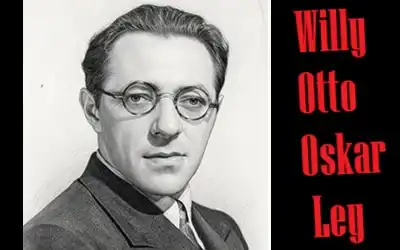
Willy Otto Oscar Ley
1910 - 1920
Following the marriage of Willy's parents in 1909, they did not establish a permanent home. According to biographers, Willy's father worked as a traveling wine merchant. A PDF download from the NASA website [*1] informs us that his father was in New York City in 1910, and by 1913, he had moved to London, England, where he opened a German delicatessen. Willy Ley's mother joined her husband in England, leaving Willy in Berlin, where the May family took care of him.
Willy's grandfather was a Church sexton, living on Scharnhorststrasse 24 in Berlin. According Willy himself in later life, when his mother left he was raised by 2 aunts and his grandparents. , however they are not called by name. I opened the baptism registers (Taufregister) and civil marriage registers (Heiratsregister) from Berlin that confirms this entire family layout.
Grandparents Willy Ley [*2]
Grandfather: Gustav Emil Oskar Maÿ
Born: 12 February 1845 (Baptized: 30 March 1845 at the Berlin Dom)
Died: 10 October 1927 in Berlin.
Grandmother: Friederike Wilhelmine Mathilde Schultze
Married Gustav: 31 May 1868 in Berlin Lichtenberg.
Died: After 1927 (Listed as surviving spouse in Gustav's 1927 death record).
Great-Grandparents (Gustav's Parents): Friedrich Wilhelm Maÿ & Dorothea Charlotte Elisabeth Kuttner
Children of Gustav & Friederike: [*2]
- Elisabeth Hulda Martha Maÿ (Born: 1868. Married Wilhelm Carl Heinrich Weigel on 8 November 1890)
- Antonie Hedwig Johanna Maÿ (Born: 1870. Married Franz Otto Wegener on 30 December 1889)
- Otto Robert Max Mäy (Married Martha Antonie Bertha Gutheit on 4 December 1897)
- Charlotte Wilhelmine Frida Maÿ (Born Mother of Willy Ley. Married Otto Julius Leÿ on 20 March 1909)
- Theodor Julius Hugo May (Died: 14 February 1939 in Berlin)
From this information we can see that Elisabeth Hulda Martha Maÿ and Antonie Hedwig Johanna Maÿ were the two aunts Willy Ley referred to when he spoke of the relatives who raised him. While his parents were living in London, Willy spent his childhood in Berlin, most likely at his grandparents’ home on Scharnhorststraße 24.
When the First World War began in late July 1914, German citizens throughout the British Empire were detained and sent to internment camps. This included Willy’s parents. His mother, however, was allowed to return to Germany. She did not remain in Berlin; according to some unverified accounts, she left the city to work as a milliner elsewhere. Willy’s aunts thus became his primary caregivers, supported by a wider network of relatives connected to the German Lutheran Church.
Julius Otto Ley’s Arrest [*3]
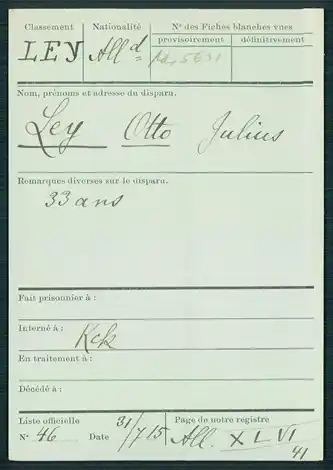
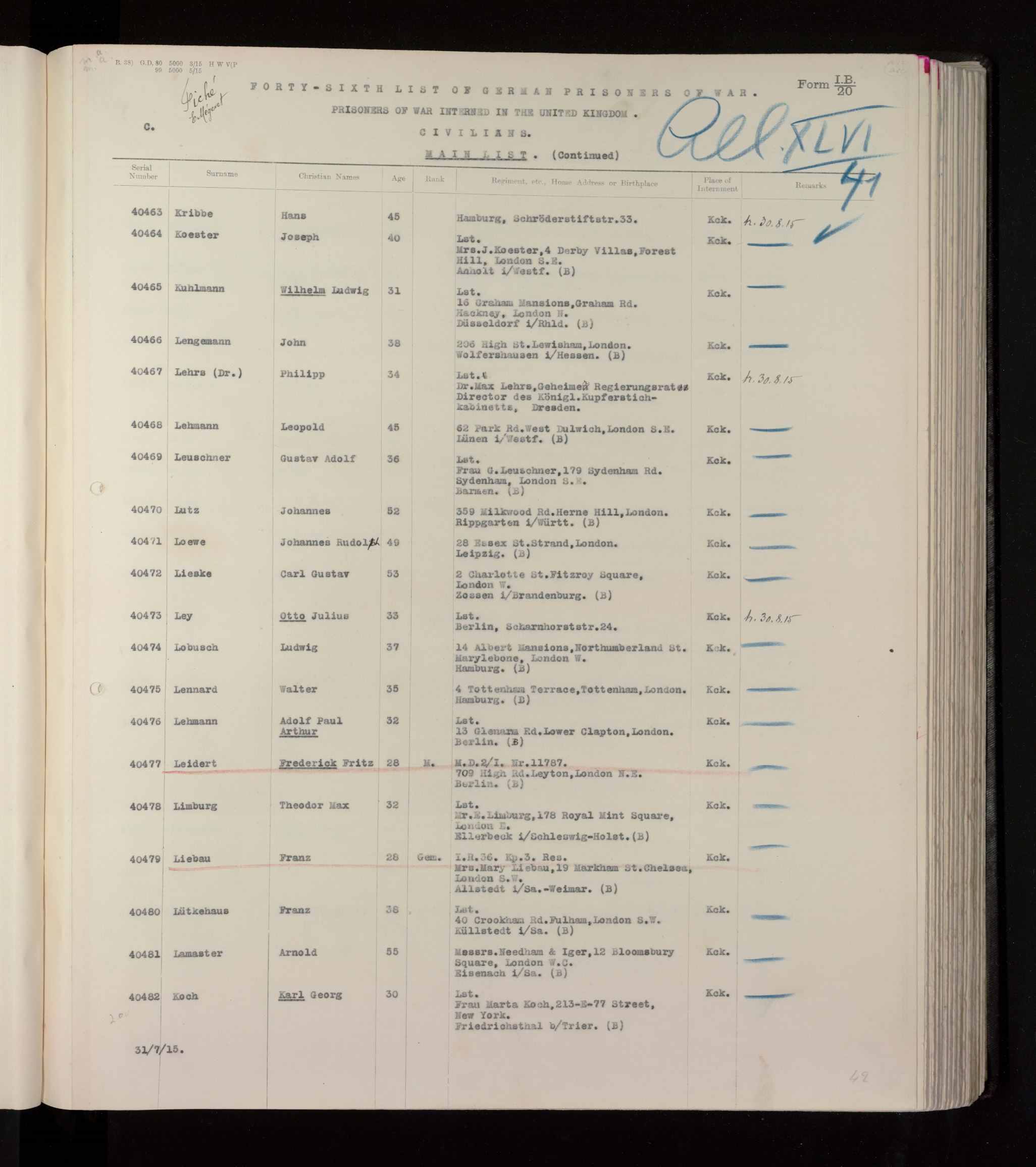
The First World War broke out on 25 July 1914. On 4 August 1914 Britain declared war on Germany, and the British Empire quickly began detaining German citizens throughout its territories. A central task of the International Committee of the Red Cross (ICRC) was to register these internees and maintain records that allowed separated families to remain in contact. Among those documented was Julius Otto Ley. his Red Cross registration shows that he was registered at the internment camp on the Isle of Man on 31 July 1915—nearly a year after the war began.
The facility, known as Knockaloe (KCK) Internment Camp, held civilian men of military age (roughly 17 to 45) whom the British authorities classified as “enemy aliens.” Its population consisted of men holding German, Austrian, or Hungarian citizenship, ranging from holidaying tourists to long-term expatriates who had lived in the British Empire for years or even decades. The Red Cross records identify him as Willy Ley’s father through the address Scharnhorststraße 24, Berlin—the home of his father-in-law, Gustav Emil Oskar May.
This timeline raises a clear question: why the long interval between the outbreak of war and Ley’s registration at Knockaloe? When was he actually arrested, and where had he spent the intervening months?
The South African Connection [*3]
Willy Ley’s father was arrested thousands of miles away from London in Johannesburg, South Africa. Contemporary Red Cross records show he was detained on 25 August 1914— within weeks after Great Britain had declared war on Germany. Because of his location, he was first held in a local facility in the Transvaal region.
He remained in the South African internment system until 4 May 1915, when he was transferred to the United Kingdom. This explains how he came to be registered at Knockaloe on 31 July 1915, nearly a full year after the war began. His arrest in South Africa also raises questions about the reasons for his presence in Johannesburg.
Red Cross Classification / Index Card (WW I era) [*3]
- Name: Ley – Otto 5631
- Address: German Consulate, Johannesburg; Essen a. d. Ruhr (B)
- Remarks: 5787/C
- Interned at: South Africa
- Official list: No. 205, dated 6/3/15
- Register page: 267 *
The reverse of the card notes: [*3]
LEY 5631
All au Transvaal
Ley Otto. en Août, employé à Johannes au journal “Süd-Afrikan. Ztg”
Int. Prisoners of War Camp
South Africa
Tr: 4.V.’15
267*
Rép. Die Handelskammer zu Bielefeld
File 5787/C [*3]
Military unit: I-R-15 (Infanterie-Regiment Nr. 15, 2nd Westphalian Infantry Regiment, based in Minden)
Status: (B) = reservist (Beurlaubtenstand), not yet called up
Home town: Essen an der Ruhr
Contact address: German Consulate, Johannesburg
Date: 25 August 1914 (South Africa)
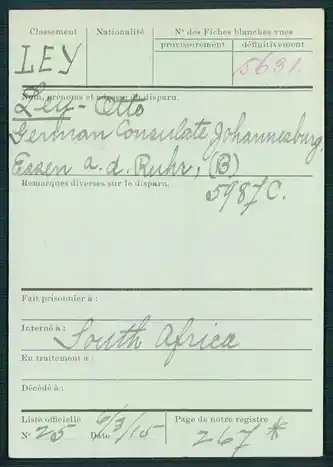

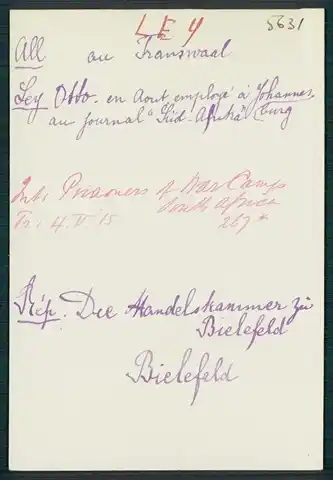
These primary sources confirm that Willy Ley’s father was in South Africa when he was arrested by the British in August 1914. File number 5631 links his South African record to the Knockaloe (KCK) Internment Camp file. The reference “Tr: 4.V.’15” shows that he was transferred to the United Kingdom on 4 May 1915. He was eventually brought to Knockaloe Internment Camp on 31 July 1915, where he remained until the end of the war.
At the time of his arrest in Johannesburg he was recorded as an employee of a newspaper (Süd-Afrikanische Zeitung). This detail casts his pre-war travels in a different light: rather than (or in addition to) working solely as a traveling wine merchant, he appears to have been involved in the news business. His wife could have operated the German delicatessen in London while he traveled, with London serving as a more practical base than Berlin for international connections.
The reverse of the card also records that the Chamber of Commerce in Bielefeld (Handelskammer zu Bielefeld) contacted the Red Cross about him. This may indicate that he ran a business and that the Chamber of Commerce was searching for him. I have not yet located any corresponding files at the Chamber of Commerce in Bielefeld, which may contain further information about the nature of Julius Otto Ley’s business.
Conclusion
Once again we see that the stories told by Willy Ley himself—and by biographers who have repeated his accounts without checking them—are often far removed from the primary sources and, at times, simply incorrect. This research into Willy Ley shows that much about his early life has either not been investigated or has been overlooked.
It is important to note that, although unlikely, it is not yet possible to completely dismiss the possibility that the Red Cross made a numbering error and merged records belonging to different individuals with similar names into a single file. The chance is very small, but at this stage it cannot be ruled out with absolute certainty. The files of the Chamber of Commerce in Bielefeld could provide the final confirmation; if anyone has access to them, I would be grateful if they could share the relevant material with me.
In part one I used primary sources to show that Willy Ley was born illegitimate. In this part two I demonstrate that his father was more than a traveling wine merchant and identify the names of the aunts who raised him. Buckle up for part three (1921–1930): there is much more that has not been told about Willy Ley, and it is very dark.
To be continued...
[*1] nasa pdf [*2] May Family [*3] ICRC Ley