
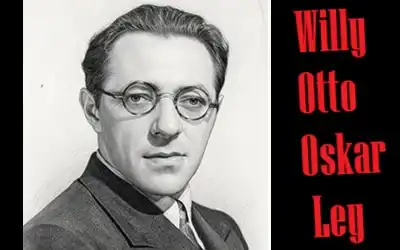
Willy Ley
1935–1945: Not One Critical Nazi Article
Historians and biographers frequently claim that Willy Ley wrote articles criticizing the Nazi regime after arriving in the United States. In this article, we examine those claims directly by analyzing what Willy Ley actually published between 1935—the year he emigrated to the USA [*4]—and 1945, the year World War II ended.
“Fog” (December 1940)
Published in the December 1940 issue of Astounding Science-Fiction (Vol. 26, No. 4, pp. 80–102 [*1]) under the pseudonym “Robert Willey,” “Fog” is routinely cited as an early example of Ley exposing Nazi totalitarianism. A page-by-page examination of the primary source shows otherwise.
The Literal Text and Villains: “Fog” is a fictional novelette, not a political article, and its antagonists are explicitly Soviet and domestic Bolshevik revolutionaries—not Nazis or fascists. Early scenes feature an agitator quoting Karl Marx, dismissing free speech as “bourgeois prejudices,” and praising “Russia, one of the biggest and most progressive, with a really good government” (p. 83), while a young office worker hands out the Communist Party newspaper The Worker (p. 84). When the coup breaks out under a red sky, a character calls it “C’est la nuit rouge” (“The Red Night,” p. 92). Once in control, the rebels wear red armlets, rename Washington Square “Red Square,” rename the Daily Post The Red Flag (reprinting a street-fighting manual from a Moscow institute, p. 96), and post an official AMWOSOV (American Workers’ Soviet) proclamation signed by Russian leaders incorporating the United States into the “Union of Socialist Soviet Republics of the World” (pp. 97–98). The story closes with U.S. Army regulars crushing the failed attempt at “establishing local ‘Red’ governments” (p. 102). Adolf Hitler, National Socialism, and Germany are never mentioned once.
Ideological Continuity (1925–1940): As a registered member of the NSDAP from 29 July 1925 to 15 October 1928 (membership card no. 11664 [*2]), Ley belonged to a movement defined by militant anti-Bolshevism. Writing an anti-Communist thriller in 1940 continued to target the ideological enemy against which the NSDAP had defined much of its political identity. The story contains no criticism of National Socialism.
The 1940 Editorial Framing: In the December 1940 Table of Contents and on page 80, Astounding introduced “Fog” simply as “A tale of revolution in an American city—by a man who’s lived through five revolutions in a major power,” framing the story around the street-level revolutionary chaos of Weimar Germany rather than an anti-Nazi warning.
Never Reclaimed as Anti-Nazi: “Fog” was never republished under Willy Ley’s real name, nor did Ley ever claim in any postwar writing or interview that the story was intended as a critique of the Nazi regime—that interpretation was invented later by biographers.
Conclusion on “Fog”:
“Fog” provides no evidence that Willy Ley was an anti-Nazi writer in 1940. It was a pseudonymous anti-Communist science fiction story—targeting the same Bolshevik enemy he had opposed as an NSDAP member from 1925 to 1928—that never mentioned Hitler, National Socialism, or fascism, and was never claimed as an anti-Nazi work by Ley himself. Labeling “Fog” an anti-Nazi allegory is a retrospective interpretation unsupported by the story's actual contents, and one that aligns Ley's 1940 output with his later postwar image.
PM—New York’s newspaper
Biographers frequently point to Willy Ley’s wartime employment at PM—New York’s fiercely anti-fascist, left-leaning daily newspaper—as proof that he actively campaigned against the Nazi regime in the American press. An examination of his actual output shows that association with an anti-fascist newspaper is not the same as writing anti-Nazi journalism.
Strictly Technical Beat: Hired in 1940 as PM’s science and military weapons editor (a post he held until becoming a naturalized U.S. citizen in 1944), Ley wrote technical explainers on ballistics, military hardware, and German rocket technology—not political or ideological critiques of National Socialism.
Reassuring the Public, Not Exposing the Regime: Even when writing directly about German weapons—such as his 1944 analyses of the V-1 “robot bombs” and V-2 rockets—Ley focused on engineering specs, fuel calculations, and explaining why German missiles could not reach New York City. His columns treated German rocketry as a technical engineering subject rather than a political indictment of the Third Reich.
Image Over Substance: As historian Jared S. Buss notes in his study of Ley’s career, working for PM allowed Ley—still legally classified as a German “enemy alien” after December 1941—to publicly align himself with New York’s most visibly anti-fascist newspaper [*5], gaining political cover without having to write an ideological attack on his former party or country.
Conclusion on PM (1940–1944): Willy Ley’s work at PM demonstrates smart self-preservation, not anti-Nazi activism. While the newspaper itself took an outspoken anti-fascist editorial stance, Ley’s own columns remained safely within the bounds of technical science and weapons analysis—giving him the public halo of an anti-fascist journalist during World War II without producing a single political critique of National Socialism. [*3]
“Future of the Robot Bomb” (November 1944)
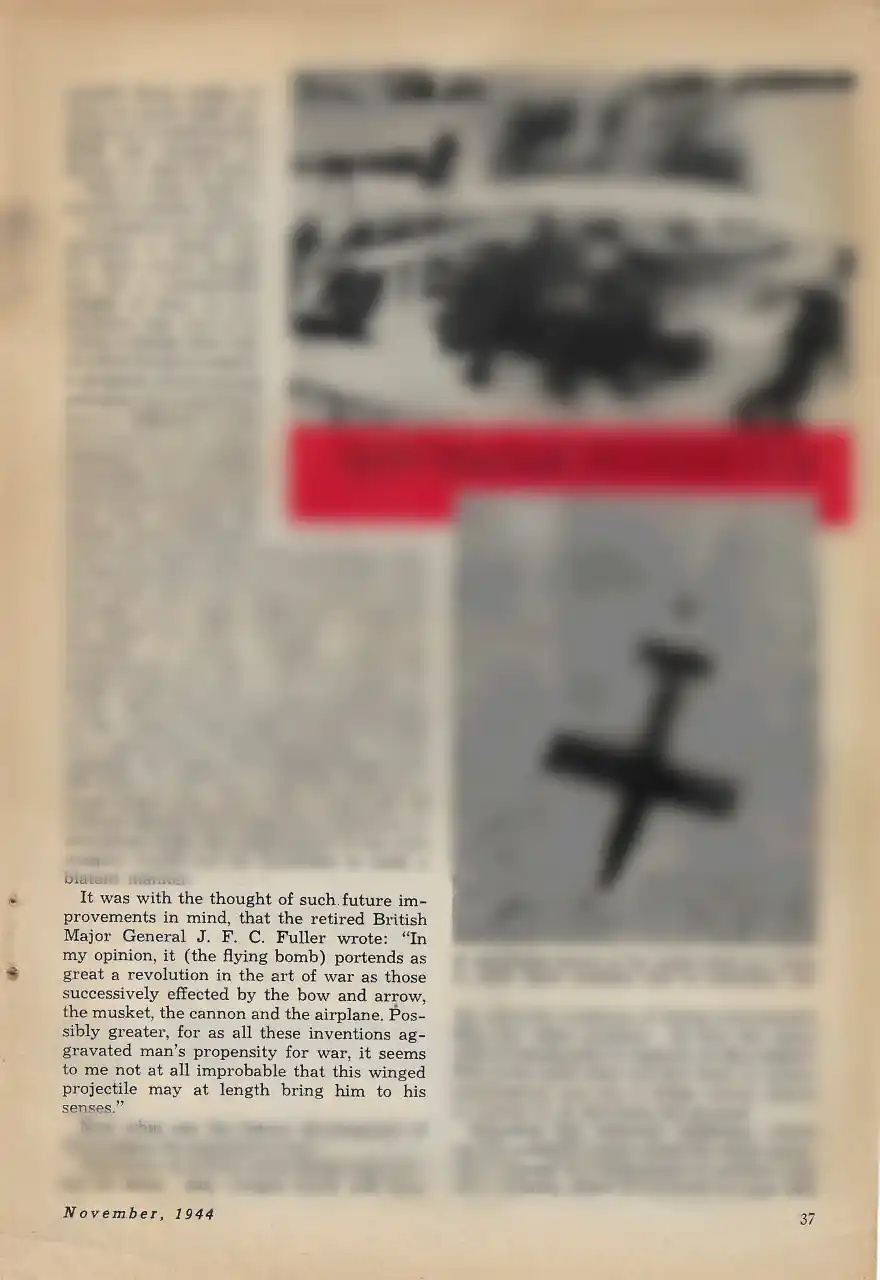
Even in late 1944, when Germany was firing V-1 flying bombs at London, Ley devoted a five-page feature to the weapon in Mechanix Illustrated (November 1944, pp. 35–37, 142, 144). He approached the subject as a military-technical analyst, without using the opportunity to criticise the Nazi regime responsible for deploying it. [*6]
Purely Technical Military Analysis (pp. 35–37): Across the entire article, Ley treats the V-1 flying bomb strictly as an engineering and tactical problem—comparing it to 1918 U.S. Navy aerial torpedoes and World War I’s Paris Gun, calculating fuel consumption at “about one gallon of fuel per mile travelled” (p. 36), and outlining how to eliminate stationary launch ramps in future designs (p. 142). Adolf Hitler and National Socialist ideology are not mentioned.
Uncritical Citation of a Prominent British Fascist (p. 37): To argue that future winged projectiles could revolutionize warfare, Ley favorably quotes “the retired British Major General J. F. C. Fuller” —one of Britain’s most prominent fascists, chief military strategist for Oswald Mosley’s British Union of Fascists, and an honored guest at Adolf Hitler’s 1939 birthday parade—without a word of political qualification, demonstrating that Ley invoked Fuller's military authority without providing readers with any qualification concerning Fuller's prominent fascist associations. [*7] In January 1935, Fuller had published an antisemitic article about Jews titled “The Cancer of Europe” in The Fascist Quarterly. [*10]
Only One Passing Reference to “Nazis” (p. 142): Only the magazine editors’ photo captions on pages 35–36 use the word “Nazi.” In Ley’s own text, the word appears in just a single closing paragraph on page 142 regarding postwar deterrence—attributing Germany’s defeat simply to the weapon “not [being] sufficiently developed” in time rather than offering any ideological or moral critique of the regime.
Minimizing German Culpability (p. 144): In his closing column on page 144, Ley inserts a parenthetical defense of the German public—claiming that “(and even in Germany those who plan wars of aggression are always a minority)”—and concludes by crediting “a German invention” with preventing future wars.
Conclusion on “Future of the Robot Bomb” (November 1944): Even when writing directly about a German terror weapon in November 1944, Willy Ley produced no ideological or political indictment of National Socialism. Instead, he wrote an apolitical engineering analysis, cited a well-known British fascist without disclaimer, and actively minimized German responsibility for the war.
Cold Facts (1935–1945)
Between 1935 and 1945, the primary record examined here contains no identifiable articles published by Willy Ley opposing or exposing the Nazi regime. Works from this period—including the 1940 sci-fi story “Fog,” his technical and weapons columns for PM (1940–1944), and “Future of the Robot Bomb” (1944)—contain no ideological critiques of National Socialism.
Major-General J. F. C. Fuller was implicated in two separate, though overlapping, 1940 pro-German coup conspiracies.
In the Right Club (Kensington) conspiracy, Fuller was reported by an MI5 informant as calling for a “bloody revolution” at a January 1940 meeting, declaring: “I am ready to start one right away.” The conspiracy, organised around Archibald Maule Ramsay's Right Club, envisaged a military coup following German victory and the replacement of the British government with a pro-Nazi administration. The plot was disrupted in May 1940, following the arrest of key figures Anna Wolkoff and Tyler Kent. [*10]
The second conspiracy was in June 1940 a plot led by former MP and fascist John Beckett in which Fuller was slated to serve as Minister of Defence—avoiding wartime internment under Defence Regulation 18B only through his high-level military connections. Fuller himself escaped internment. Diana Mosley later attributed this to his influential connections. [*7, *8]
Fuller was not simply a retired military strategist. He was a prominent British fascist who had publicly supported Franco's Nationalist forces, expressed admiration for Mussolini and Hitler, and attended Hitler's 50th birthday celebrations in 1939. These political associations and activities were established well before Ley quoted him in November 1944. It is difficult to believe that Fuller's political identity was entirely unknown to Ley, particularly given his background and professional interest in military affairs.
Modern scholarship, such as Jared S. Buss’s Willy Ley: Prophet of the Space Age (2017), notes that his anti-fascist reputation relies heavily on postwar memoirs rather than contemporary documentation [*5]. While defenders suggest he remained silent to protect associates in Germany, his wartime publications frequently named former Verein für Raumschiffahrt (VfR) colleagues in connection with rocketry, undermining the argument that fear for their safety prevented him from writing criticism.
Consequently, Ley’s reputation as an active anti-Nazi writer during the Third Reich rests on retrospective accounts rather than identifiable contemporary primary sources from 1935 to 1945.
If anyone possesses primary-source evidence to the contrary—an actual anti-Nazi regime article published by Willy Ley between 1935 and 1945—I am more than willing to analyze it and correct this article if necessary. Until such evidence is produced, the contemporary record contains no demonstrated evidence of Ley publishing anti-Nazi articles during this period.
[*1] Robert Willey [Willy Ley], “Fog,” Astounding Science-Fiction, Vol. 26, No. 4 (December 1940), pp. 80–102.
[*2] NSDAP Membership Card No. 11664 (Willy Ley, 29 July 1925 – 15 October 1928), U.S. National Archives (NARA).
[*3] Smithsonian NASM finding aid (NASM.XXXX.0098).
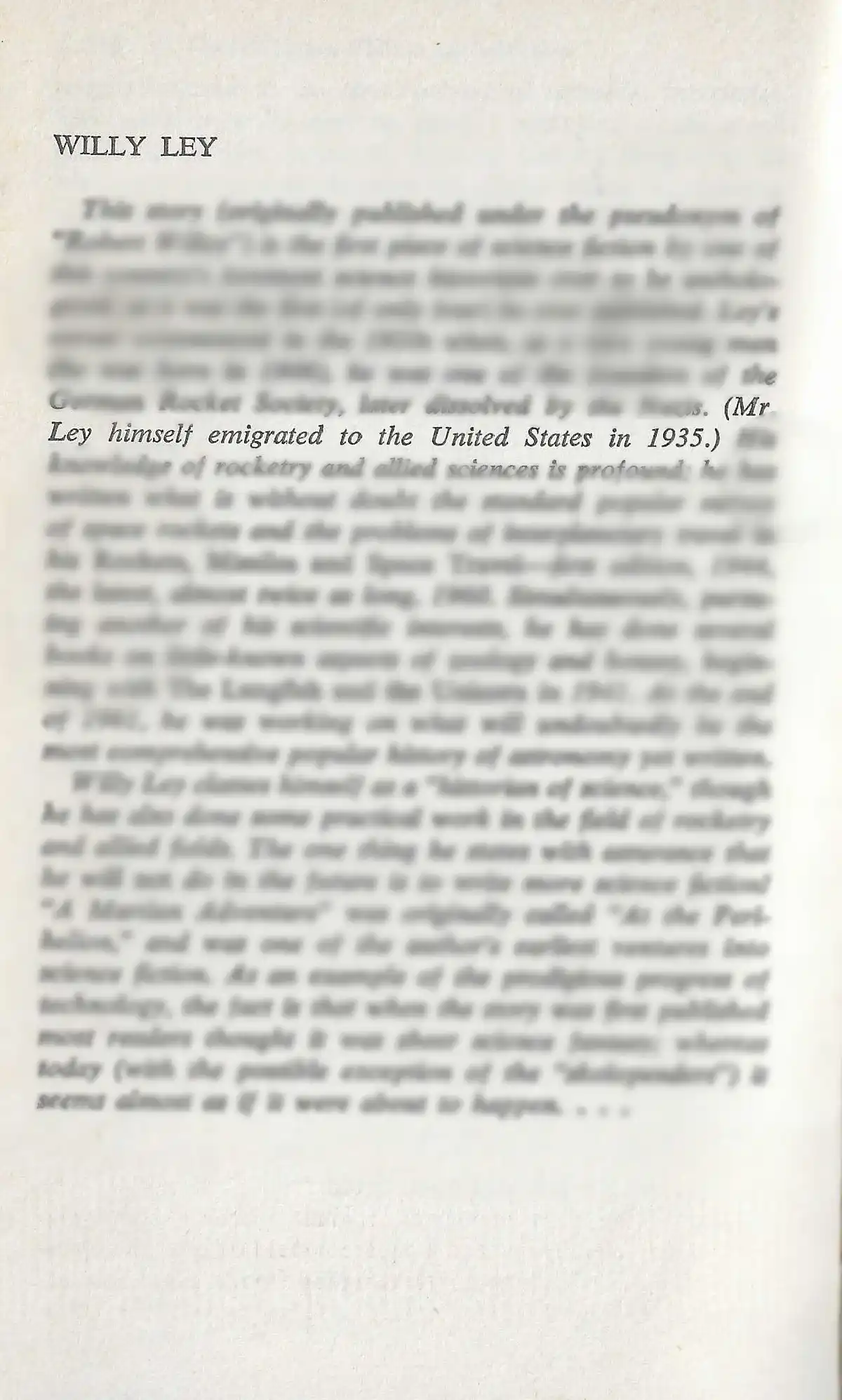
[*4] Groff Conklin (ed.), Great Science Fiction by Scientists (Collier Books, 1962), p. 171 (“Mr. Ley himself emigrated to the United States in 1935”). See Image.
[*5] Jared S. Buss, Willy Ley: Prophet of the Space Age (University Press of Florida, 2017) p. 55
[*6] Willy Ley, “Future of the Robot Bomb,” Mechanix Illustrated, November 1944, pp. 35–37, 142, 144. see image.
[*7] J. F. C. Fuller, fascist, and an occultist
[*8] MI5 Agent M/M's 1940 intelligence reports
[*9] Tim Tate, Treason, Treachery and Pro-Nazi Activities by the British Ruling Classes During World War Two (2019), p. 15.
[*10] Tim Tate, Treason, Treachery and Pro-Nazi Activities by the British Ruling Classes During World War Two (2019), p. 39, citing Report of MI5 Agent M/M, 1 June 1940, The National Archives, KV 2/1511, declassified 30 March 2004.