

Pendray’s Visit to the German VfR
AIS Newsletter, May 1931
The American Interplanetary Society (AIS) was founded on 4 April 1930 in New York City by twelve science-fiction writers and early spaceflight enthusiasts—led by G. Edward Pendray, Leatrice Gregory Pendray, and David Lasser (its first president)—meeting in the Pendrays’ apartment at 450 West 22nd Street. From its founding until 1932 the Society issued a newsletter called the Bulletin. The publication was renamed several times, just as the AIS itself changed its name to the American Rocket Society (ARS) in 1934.
In the United States, Robert Goddard had already fired multiple liquid-fuel rockets between 1926 and 1930, but after a critical New York Times editorial of 13 January 1920 he worked largely in secrecy and none of these early results were published. A second reason for his reticence is explained in an open letter he later sent to the AIS, who published it in its June/July 1931 edition. More about this later.
One of the first major steps the AIS took was a visit to the German Verein für Raumschiffahrt (VfR) in Berlin in April 1931 to observe the progress being made there. Willy Ley, then international correspondent and vice-president of the VfR, welcomed the Americans and hosted them. The report by G. Edward Pendray “The German Rockets” was published in the May 1931 Bulletin (pages 5–12). [*1]
This May 1931 primary source confirms that Willy Ley was not a co-founder of the VfR, something that has been printed many times by biographers and in articles. As this source, as well as other primary sources, clearly state Willy Ley was an early member who became the vice-president. [*1]
It also shows that during the April 1931 visit neither G. Edward Pendray nor his wife saw a working liquid-fuel engine fired. This is widely claimed today by many sources, and even by AI systems. Pendray states in his 1931 report that the tests of the First and Second Miraks, both of which had failed, were already completed before he visited the VfR in Berlin, and that the Third Mirak was not ready to be fired at the time of his visit. He does not mention any stationary test he witnessed, something he would have reported to the AIS had it occurred. [*1]
The narrative that G. Edward Pendray witnessed a 1931 static liquid-fuel firing originated with Willy Ley in his 1944 book Rockets (p. 139), which claimed that a test run was demonstrated during the Pendrays’ visit to the Raketenflugplatz:
"Test runs varied in length from thirty to ninety seconds. When Mr. and Mrs. Pendray of the American Interplanetary Society visited the Raketenflugplatz in April 1931 we could demonstrate a fine test run." [*2]
In 1945 Pendray wrote the book The Coming Age of Rocket Power, he addresses his visit to the VfR but is not mentioning he witnessed the firing of liquid fuel engines. What Pendray wrote:
“A later motor developed by these experimenters and demonstrated in 1931 to Mrs. Pendray and me as representatives of the American Rocket Society had many improvements. The motor was cooled by running water. The material was aluminum alloy, and the blast chamber was what the experimenters called ‘egg shaped,’ though inspection showed it to be cylindrical, with each end finished off in a hemisphere.
The propellants came in through two ports near the throat, directed upward so the streams of liquid oxygen and gasoline would meet near the radius of the upper hemisphere. This motor was small, weighing about a pound. It produced a thrust of about 20 pounds, at a calculated jet velocity of about 6,000 feet per second.” [*3]
In the 1945 text Pendray says the motor “was demonstrated” and then describes its design and calculated performance (if live-tested, it would be measured). He never writes that it was fired, running, or under test. In fact, Pendray lifted this exact description of the “egg-shaped” cylindrical chamber directly from his own May 1931 Bulletin report on the Third Mirak—where he explicitly wrote that the combustion chamber “had not yet been tested when I was there” and was only expected to develop a lift of more than eight kilograms (about 19 pounds). The claims by Willy Ley that Pendray and his wife had witnessed a working liquid-fuel engine test during their April 1931 visit are not supported by contemporary primary sources in 1931 and 1945.
As always, if you have sources that contradict what I have written, please contact me at X @awe_130. I am more than happy to correct this article. For now, however, the primary sources speak clearly, and they show that Willy Ley invented a great deal.
See part 2 AIS Newsletter, May 1931.
May 1931 edition of the Bulletin page 5 to 12
* * * * * * *
THE GERMAN ROCKETS
(Abstract of a Report by G. Edward Pendray to the American Interplanetary Society at Meeting of May 1, 1931 on the Results of the German Experiments with Rockets. This information was gathered by Mr. Pendray on a trip to Europe in April 1931.)
The German Interplanetary Society and the Raketenflugplatz
The Verein fur Raumschiffahrt, which may be translated "The Society for Space Flying", and which has now been also entitled "The German Interplanetary Society" by its leaders, was founded in July, 1927, in Breslau by Johannes Winkler, an airplane engineer, and the late Max Valier. In the following month Dr. Hohmann, of Essen, became a member, followed by Professor Oberth, who is now the society's president, and Willy Ley, now its vice-president and secretary. Winkler was the first president, but he was connected with the Junkers Airplane works at the time. His employers objected to his connection with such visionary schemes as rocket flights and interplanetary speculation, and he was forced to resign. Valier then became president. Oberth had an assistant who outlined a plan for a simple rocket, without intricate pumps, and which could be built for comparatively little money. This man was Rudolf Nebel, a diploma engineer, and now director of the experiments at the Raketenflugplatz, which is the name of the rocket flying field near Berlin.
Also in the society was Klaus Reidel, a young engineer whose uncle owned a factory at Bernstadt. Encouraged by the society, these two men went off to Bernstadt, where, in June a year ago, they built and tested the first complete, continuously-burning liquid fuel rocket ever constructed, so far as is known. This rocket was constructed on the smallest scale considered feasible by Nebel, and was therefore called the Minimum Rocket. After the fashion of the Germans, this name was quickly shortened to Mirak. Later it became necessary to refer to it as the First Mirak.
Goddard, who has carefully prevented the results of his work from becoming public, is said to have sent up his 1929 rocket by a series of explosions, instead of continuous fire. It is difficult to see how this was managed, but in any case, it is clearly not the solution to the problem.
Others, including Oberth and Robert Esnault-Pelterie, have been convinced that the first step would necessarily be to build pumps capable of handling the liquids and jetting them into the chamber. Several types of such pumps have been designed or described, but it remained for Nebel and Reidel at the Raketenflugplatz to show that for the present, at least, pumps of a mechanical type are not necessary.
Their work rests upon experiments performed by Oberth, Valier and Dr. Heylandt prior to 1930, when all three of these men were at work on the liquid fuel problem. Valier and Heylandt announced the first continuously-burning liquid fuel motor, but they did not attempt to adapt it to the rocket, but rather to the automobile. It was during experiments of this kind that Valier was killed.
To Oberth and Valier belong the credit for discovering the point and direction in which the fuels must be introduced into the
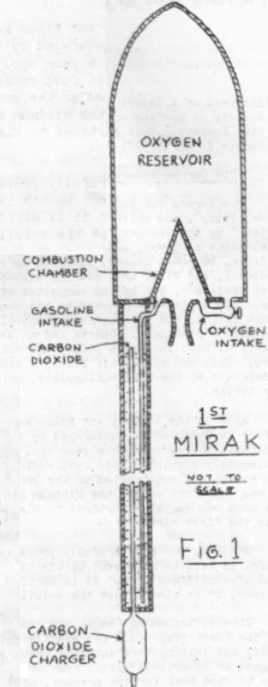
combustion chamber. Armed with this information and his technical experience, Nebel set out in his first Mirak to adapt the recoil motor to an altitude rocket. How he did it may be seen by a study of the diagram of the First Mirak (Fig. 1).This diagram, and the others to be shown presently, are not drawn to scale, and were prepared only to make clear the nature of the German experiments and the succeeding steps by which they have advanced.
The First Mirak, the scheme of which is shown in the diagram, was built of duralumin, and consisted of three parts: the upper tank, for oxygen, the lower tank, for gasoline, and the combustion chamber. Observe how this rocket clearly indicates the complexities brought into rocket construction by the use of liquid fuels.
In the First Mirak the combustion chamber, following early ideas as to the proper construction of recoil motors for this use, was cone-shaped, made of heavy copper alloy, and was without special lining of any kind.
The two fuel tanks were built of dural. The upper one held about a litre of liquid oxygen, the lower about half a litre of gasoline.
The oxygen was forced into the combustion chamber by the pressure of its own gas, which forms quickly whenever the vessel is closed. The gasoline was forced in by carbon dioxide gas; furnished by the small siphon charger at the lower end of the chamber. By these simple expedients Nebel and Reidel overcame the pump dilemma which had stumped Oberth in the building of his Baltic rocket, and had caused so much discussion and thought among other rocket designers.
The Mirak weighed, loaded with fuel, about three kilograms (six and a half pounds), and firing tests against a spring balance apparatus showed that it had a lift of four and a half kilograms, or nearly ten pounds. In short, if the First Mirak had not been tied down during these tests it would have flown.
It was the expectation of the inventors that the oxygen would need some heating to produce the necessary pressure, and also that the combustion chamber would need some cooling. They hit upon the idea of placing the combustion chamber directly in the oxygen tank, as shown, to satisfy both requirements at once. This was found to be unsatisfactory, for the oxygen was heated too much—it needed no heat anyway—and the cooling effect was insufficient to offset the danger involved in this arrangement.
Another thing, learned was that the cone-shaped combustion chamber was unsatisfactory. The odd corners at the base appeared to obstruct the rapid flow of gases, and the forward pressure developed was disappointing. It was clear that more room was needed in the middle and top of the chamber for the mixing of the fuels and the explosion.
Finally the behavior of the oxygen, which at the end developed such tremendous pressure that the tank was burst, showed that the Mirak needed a safety valve through which the excess pressure could escape.
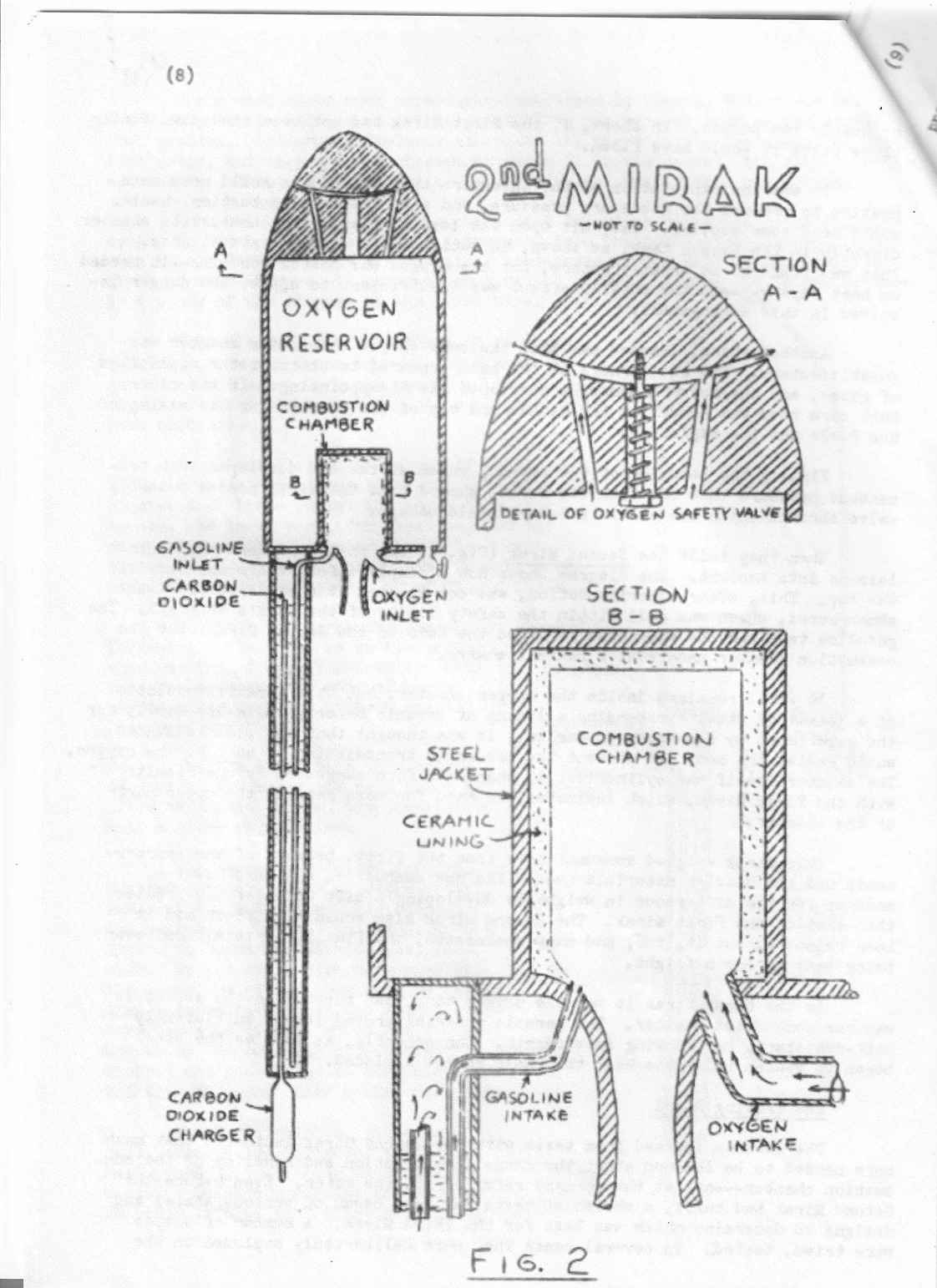
When they built the Second Mirak (Fig. 2) the engineers took these first lessons into account. The diagram shows how a simple safety valve was made at the top. This, after experimentation, was set to open at a pressure of six atmospheres, which was well within the safety limits of the tank’s strength. The gasoline tank and its apparatus remained the same in the Second Mirak, but the combustion chamber underwent a radical change.
It still remained inside the oxygen chamber, but this time it consisted of a jacket of steel surrounding a lining of ceramic material made especially for the experiment by a company in Berlin. It was thought that the ceramic lining would resist the heat and prevent the too-rapid transmission of heat to the oxygen. The chamber itself was cylindrical in shape—a form suggested by the results with the First Mirak, which indicated the need for more room in the upper part of the chamber.
This Mirak weighed somewhat more than the First, because of the improvements and the heavier materials used. The new combustion chamber, however, made up for the difference in weight by developing a lift considerably greater than that of the First Mirak. The Second Mirak also would have flown had it been released, but it, too, had many weaknesses, and finally burst without ever being sent up for a flight.
In the First Mirak it was the oxygen tank that burst. In the second it was the combustion chamber. The ceramic material proved itself sufficiently heat-resistant, but lacking in strength. Consequently, as soon as the steel began to weaken under the heat the whole rocket exploded.
The Proving Stand
The lessons learned from tests with the Second Mirak indicated that much more needed to be learned about the shape, construction and handling of the combustion chamber—or, as the Germans refer to it, the motor. Even before the Second Mirak had burst, a series of tests had been begun on various shapes and designs to determine which was best for the Third Mirak. A number of shapes were tried, tested. In several cases they were deliberately exploded on the proving stand. A technique was worked out for testing these motors which it may be useful for us to observe.
The proving stand was set up in a deep ravine on the Raketenflugplatz, where an explosion would hurt nothing. Because it suited the purpose, the engineers took the small steel tower and planted it firmly at the bottom of the hollow. On either side, partly covered by the banked-up earth, they placed tanks for fuel. At the right was the oxygen tank, at the left a gasoline tank communicating with a tank of nitrogen gas under pressure. The valves of both tanks were arranged so that they could be opened from a distance, by the turning of a wheel connected to them by wire cables.
Balanced in the proving stand like the arm of an old steelyard scales is a metal rod about six feet long, with a pivot at the center. At one end was a clamp for fastening the recoil motor under test, and an adjustable weight which the motor must lift if it has power enough to raise its end of the arm.
At the other end was fixed a clockwork device with a revolving drum of smoked paper and a needle fastened to the movable rod. When the test was ready the combustion chamber was fired, the fuels turned in, and the drum set to revolving by its clockwork. The amount of lift of the motor is accurately recorded on the drum, which can later be taken off, the curve calibrated, and the behavior of each motor studied and preserved for comparison.
In carrying on tests, the combustion chambers are placed in a small tin tank of water, the water being continually replenished by a hose. The usual procedure on the stand is to run a little liquid oxygen through the motor first, in order to begin the test with the metal as cool as possible. Then the gasoline flow is started. An electric spark ignites a wick, which blazes near the mouth of the nozzle. Then the oxygen is turned on. An explosion follows, blowing the wick away and starting the recoil.
During the first few instants the motor sputters a little. Then, as it begins to warm up, the fire grows steady. A jet of yellowish flame spurts downward from the mouth of the nozzle about three or four feet, accompanied by a furious hissing sound not unlike the roar of steam escaping under high pressure. An instant or two later the length of the flame shortens perceptibly, loses most of its color and becomes bluish, at times becoming almost invisible. With this change the sound becomes more intense. The power of the combustion is apparent even at a distance of several hundred feet. The earth seems to tremble with the vibration of the rocket motor.
A minute of such firing seems like a long time. It is usual in the tests not to fire for more than a minute to a minute and a half at each time. By this time the water in the little tin tank, which was frozen at the beginning of the test, is boiling, but the copper lining of the motor has not melted and is only slightly oxidized. When the fuel is shut off the oxygen reservoir is closed first, permitting pure gasoline to jet into the hot chamber. If it were otherwise the oxygen would immediately attack the hot metal, cutting it out.
In actual flight these small motors are not expected to burn more than thirty or forty seconds, and in this time the problem of overheating is not particularly serious. On the proving stand small motors have been fired for as long as five minutes, with water cooling, but all so tested have exploded with great violence before ten minutes of continuous firing have passed. These tests have shown that the greatest heat is developed near the head and at the sides of the chamber, and not at the constricted throat, as many engineers had expected.
Taking the lesson learned by the unfortunate death of Valier, the German experiments are now being carried on with every possible precaution. The fuels are always controlled from a distance, and observation from the bank above the proving stand is made safe for the engineers by a double-mirror device which permits them to watch while completely behind cover. For necessary close observation and photography a covered dugout with a parapet of sandbags has been constructed a few feet away, in the side of the embankment.
The Third Mirak
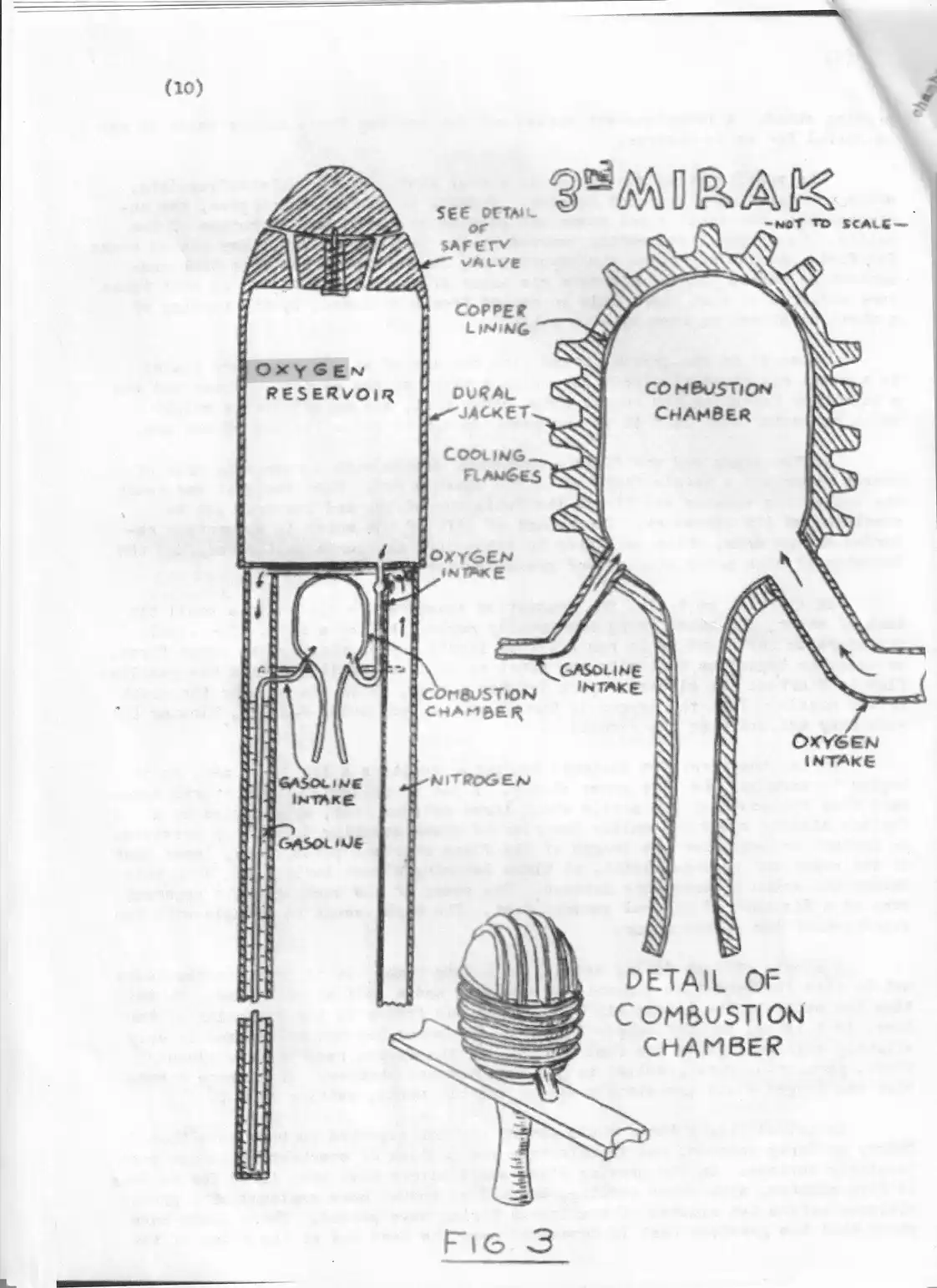
Under these conditions the tests were made preliminary to the building of the Third Mirak, which was nearly complete three weeks ago, but had not yet been tested in the assembled form. The Third Mirak (Fig. 3) differs in certain important respects from its predecessors, the principal changes having been made in the construction of the gasoline fuel tank apparatus and the shape and position of the motor.
Instead of one lower tank we now have two, so weighted and constructed as to balance each other. One carries the gasoline fuel, the other a charge of nitrogen gas under pressure. A pipe connects the two so that the gas, pressing on the liquid, forces it into the combustion chamber when the valve is opened. The substitution of nitrogen gas for the carbon dioxide charger of the earlier experiments followed a number of tests which showed the new method to be more dependable and steady. Under the new method the full pressure is available at once, whereas by the charger method there was an appreciable lag.
The other important change in the Third Mirak has to do with the shape and position of the combustion chamber or motor. As the diagram shows, the motor chamber is now what the Germans call “egg-shaped”. Actually it is cylindrical, with each end finished off in a hemisphere.
This shape was decided upon for the Third Mirak as a result of the tests upon the proving stand. It is built of duralumin, with an inner lining of copper. The choke is somewhat greater in the nozzle of this motor than in the others, and the ejection tube somewhat longer. The copper lining covers the whole inside, including the nozzle to its end. It is about a sixteenth of an inch, or a little more, in thickness.
With the adoption of this shape of combustion chamber, and particularly with this placing of the fuel inlets, a curious effect has been noticed. Whereas the pressure in the chamber is from twelve to twenty atmospheres, the pressure required to send the fuels in is much less than that. The phenomenon appears to be the result of currents set up in the chamber during combustion, which actually seem to create a kind of suction upon the intakes. It is the theory of the engineers that the gases move upward along the walls, meet at the top and explode, the outgoing gases rushing directly downward through the orifice.
The Third Mirak is obviously somewhat heavier than the earlier Miraks. It was expected to weigh, loaded with fuel, about four kilograms (about 9 pounds). The amounts of fuel are about the same as in the First Mirak—namely, a litre of oxygen and half a litre of gasoline. The nitrogen in the pressure chamber is under a pressure of ten to twelve atmospheres; the safety valve at the top of the oxygen tank is set to open at six atmospheres.
The pressure inside the combustion chamber, due to the greater choke at the neck, is higher than in the earlier Miraks, and will probably reach fifteen to twenty atmospheres. Experience has shown that the higher the pressure in the chamber, the longer the stem of the ejection nozzle should be. The flare of the nozzle is not great. In these small motors the engineers claim to have found little advantage in making the flare mathematically correct, though elaborate calculations have been made, notably by Guido Baron von Pirquet in Vienna, to determine what the exact flare should be. It varies for each fuel and fuel mixture but even so, it is not as great as we had anticipated in this country.
The combustion chamber designed for the Third Mirak, which had not yet been tested when I was there, is expected to develop a lift of more than eight kilograms (about nineteen pounds) and possibly ten kilograms (about 22 pounds).
At 8 kilograms the acceleration of the Third Mirak should be one gravity at the start. The rate of acceleration of course increases as the fuel is burnt in proportion to the increasingly smaller weight of the rocket. Since the starting load of fuel weighs about three pounds, the rocket itself weighs only six pounds, and the acceleration in the last moment of fire should theoretically be about two times gravity, or 64 feet a second.
The Third Mirak is expected to fire thirty-two seconds, using four times as much oxygen as gasoline by volume. Theoretically, it should rise well over three miles. Air resistance and other difficulties may be expected to cut this distance, so that the actual flight expected is about two miles.
If this performance seems small and unimportant, remember that a successful flight of any kind has never been made with continuously burning liquid fuel. If the Third Mirak flies at all it will be a matter of tremendous historical importance. Remember also that the Mirak, as its name implies, is the minimum size contemplated. If it is a success the way will be paved for the immediate building of much bigger ones, plans for which are all ready being drawn.
It is clear that an increase in size will be an advantage, even if it should happen that there were no increase in efficiency. Thus, a rocket with twice the capacity, both in the fuel tanks and the combustion chamber, need not weigh twice as much. Other things being equal, the proportion of construction weight to that of the fuel carried becomes smaller and smaller as the size increases. The fuel capacity of the Third Mirak could probably be doubled, for example, without adding much more weight than the weight of the extra fuel. Yet the rocket would fire and continue to accelerate twice as long, and would theoretically make an altitude of twelve or fifteen miles as compared with the Third Mirak’s expected two or three.
[*1] May 1931 edition of the Bulletin page 5 to 12 [*2] Willy Ley, book Rockets 1944 p. 139 [*3] Pendray book, The Coming Age of Rocket Power 1945